Thursday Challenge: Dreidels

Thursday Challenge theme is TOYS (Cars, Dolls, Video Games, Puzzles, Balls, Board Games,…).

Thursday Challenge theme is TOYS (Cars, Dolls, Video Games, Puzzles, Balls, Board Games,…).

Each night of Chanukah we light one more candle, until by the eighth night we have eight candles lit. This is to remember the miracle that happened in the Temple a long time ago, when one little container of oil that should have lasted for only one day lasted for eight. In the photo are four orange candles for the fourth night, and the purple one called the “shamash.” The shamash is an extra one, the helper; the shamash lights the other candles. One can choose any colors; my daughter picked these colors. My sons and husband use an oil chanukiah (menorah), as the one in the Temple used oil.

I’ve been taking many photos of the lights, or as the title of this post declares, I’ve been “playing with fire.” Here’s the photo of the candles on a jar, using the warp tool in Photoshop as instructed in this tutorial on the warp tool effect.

This was my kitchen way back in July. See the tomatoes on the window sill? Must have been a bountiful week. The tomatoes are gone, but the clutter is still there.

This was in my kitchen last Friday: doughnuts for Chanukah (we have a custom of eating foods fried in oil to remember the oil that miraculously lasted for 8 days) and challah for Shabbat (the commandment or mitzvah is to eat two loaves of bread with each Shabbat meal – a rich egg bread has developed as the tradition to uphold the mitzvah). Yes, both are homemade. Little red in this photo, but it does keep with the theme of my kitchen!

And here are some red strawberries that got gobbled up last night, along with the doughnuts (sufganiyot) and latkes (potato pancakes). I also made Mimi’s fish soup and a cubed pressed salad of cucumbers and carrots that I seasoned with fresh-squeezed lemon juice, orange juice, and chopped fresh ginger root.
For more photos with red, visit Ruby Tuesday:


For more shots SOOC – Straight Out of the Camera, visit:

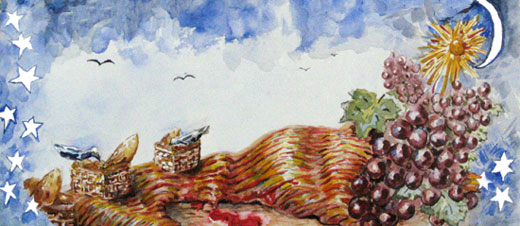
With a name like stars and stripes in the title of this post, perhaps you were expecting something else? What do you see in this painting? It is a detail of the invitation we used for my older son’s bar-mitzvah in 2007.
If you don’t know the story (or can only guess the stripes), here’s a link to the parsha.
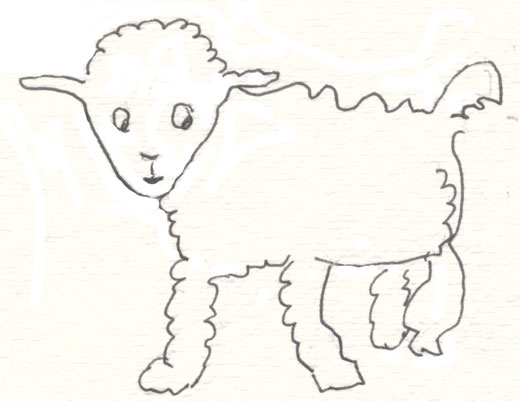
Free Association Game: What do you think of when you read sheep? Or when you look at the above image? (or both)
Please leave your thoughts, ideas, associations in the comments. As always, vulgar or obscene comments will be deleted. But the truth is, I’ve never gotten any vulgar or obscene comments…
Not necessary to play the game, but if you are curious, read the difference between a lamb and a sheep.

How does one depict an angel? How does one depict the earth, the sky, the ladder? I skipped putting the main subject, Jacob, in the painting. Maybe next time. If I were to depict Jacob, he might look like this man.

A big thank you to hosts of Haveil Havalim: Phyllis of Ima on and Off the Bima for last week and Hannah of A Mother in Israel for this week. Haveil Havalim is a weekly Jewish blog carnival.

When I think of songs that warm my soul, the songs of Shabbat come immediately to mind and heart. Lecha Dodi is sung on Friday nights – the song is a welcoming of the “Sabbath Bride.” Lecha Dodi was written in the 16th century by Rabbi Shlomo Halevi Alkabetz. I rather like this untraditional rendition of the song on YouTube.
Thursday Challenge theme is MUSIC (Guitar, Playing an Instrument, Things that make sounds, iPods, Sheet Music, Noisy Things,…).
Note: I wrote this post a year ago. And it sat as a draft in my WordPress until today. In honor of Ilana-Davita and because Raizy misses Ilana-Davita’s parsha post this week, I am now hitting ‘published.’ Please note that I never finished, but at the bottom you will see that I found a high school student who did.
One of the problems with writing about the parsha is getting it up before Shabbat is not always the easiest task, and one often has more time to review the parsha on Shabbat. So here’s a few more thoughts on the years of Sarah, before we turn to the parsha of this coming week, Toldot.
What’s the question about the opening pasuk, the opening sentence of the Torah portion? Unless you read Hebrew, you might think from the English that it only says “years” twice. However, it really says “shanah” or years 4 times. Since everything in the Torah is repeated for a reason, why so many years?
There is a midrash that goes with the story of Sarah. It’s like this:

When Sarah was 100, it was as though she was twenty in sin.

And when Sarah was 20, it was as though she was 7 in beauty.
So Rashi claims that we learn this midrash from the fact that the pasuk repeats the word “shanah” or year: 100 years, 20 years and 7 years. But the Ramban says no, we learn the midrash from the end of the pasuk, where it says “And these were the years of Sarah.” Because by Yishmael, it also has years repeated, but his years were not all alike.
And here the post ended…but Nachi Friedman provides a good summary of what the commentators had to say about this topic of Sarah’s years.