According to Wikipedia, there are many kinds of liatris. These purple flowers grow by the Raritan River at the edge of Donaldson Park, a large county park situated in Highland Park, New Jersey.
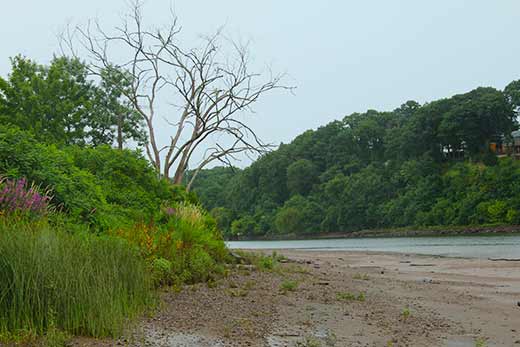
Three weeks ago, when my daughter was in camp and I had a little more time, I went to Donaldson Park and took some photos. I took several of the Raritan River, such as this one with the tall, bare tree at the river bend. I really enjoyed the Raritan River liatris, the purple spikes bursting out of the sandy banks by the river.
It was raining that day, but not enough to get me soaked, despite the fact that I had not brought a raincoat.
In this photo, you can see a little of New Brunswick, New Jersey – that’s where some of Rutgers University resides. New Brunswick is more urban than Highland Park, but it is still small, especially compared to Philadelphia or New York City. Or Newark or Trenton. Actually, all you see is a bit of the bridge of the route 18 highway.
In other nature news, I started filling my bird feeder again (it got neglected as I paid more attention to my garden, but as I explained to my kids, only in the winter am I really concerned that the birds in our area need food to eat). I’ve seen blue jays, a cardinal and mostly lots of sparrows. Maybe soon I’ll have more bird photos.
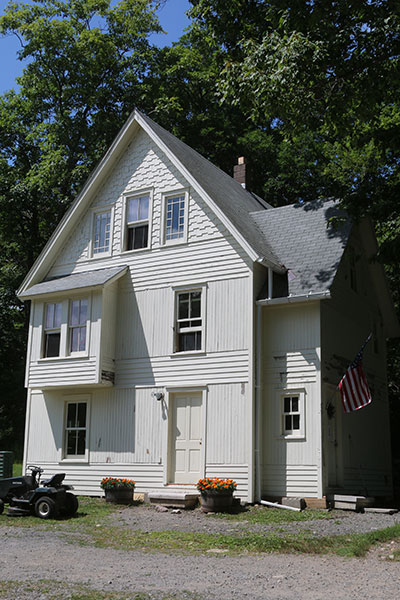
This old white house of wood was next to the visitor center on our hike in the Shawangunk Mountains. It looks like it might have once been a farmhouse. One hundred years ago this area was known for its berry pickers – hard to believe berry picking was once someone’s job. But I suppose in other parts of the world it still is.
If you visit Asbury Park, a prominent building is the Paramount Theatre. It is right on the beach, and a promenade boardwalk leads you from the theater to the old casino building. Lots of shops and restaurants have newly opened along the boardwalk. The theater (you can read its history here) was built back in 1927. Two years ago I posted Asbury Park: Pictorial History in Brief).
Finally, here’s a beach house with historical windows in Ocean Grove, New Jersey (I’m guessing that the original windows were replaced – these looks simpler than how I imagine windows once used to be). Ocean Grove is next to Asbury Park. It has a rather different history. It started out as a Methodist town – here is some history. My husband remembers when you were not allowed to ride your car in Ocean Grove on a Sunday. He would ride his bike to work at his job, and when he got to Ocean Grove he would get off his bike and walk it.
I’m linking to I Wish I Were a Photographer on Toby’s blog. As she says, I wish Israel were no longer at war – I read via Facebook of my cousins and my friends too often needing to go to their shelters to protect themselves from the missiles. Last week, a four-year-old boy was killed.
Want to participate? See Whimsical Windows and Delirious Doors.
You might think a book called Hasidic Tales of the Holocaust would make you incredibly sad. Perhaps. Well, most probably. But perhaps also it will give strength, hope, inspiration. In the forward to the book, Yaffa Eliach explains how she gathered these tales. They are based on interviews and oral histories, compiled with the help of her Brooklyn College students. She begins by relating the history of Hasidism, a movement founded by the Baal Shem Tov (1700 – 1760). From the foreword: “The main themes of Hasidic Tales are love of humanity, optimism and a boundless belief in God and the goodness of mankind.” One can see why this form of tale could be helpful in relating the horrors of horrors of the Holocaust.
“You can’t fool me there ain’t no Sanity Clause.” That phrase from the Marx Brothers movie came to mind as I was reading the book. But instead, I thought, “You can’t fool me, there ain’t no happy ending!” When I first started reading the tales, I found them so unbearably sad, I had to stop reading the book for a while. But when I picked it up again, the belief in humanity was like a spark that compelled me to read further.
For example, there is the story about Rabbi Spira who always used to say hello or good morning to everyone he passed, including Herr Muller. When Rabbi Spira was taken to Auschwitz, and it was his turn to be in the selection of right or left, he looked up, and there was Herr Muller. The rabbi was sent to the right – to life. Many years later, Rabbi Spira relates this conclusion: “This is the power of a good morning greeting. A man must always greet his fellow man.”
Another story that touched me was one of Moshe Dovid and his father, a Hasidic rebbe. Moshe Dovid was used to following his father’s advice; so when his father told him separate in order to survive, he did. He later discovered his father’s advice incorrect, and he went back to him, saying his advice did not work. His father sadly explained that these were very unusual times, and he could no longer be the one to give the sage advice. The rebbe said he is like the leader ram of the herd that a shepherd in his anger has blinded. Each person had to decide on his own and trust his own instinct. Moshe Dovid was able to survive the war.
Several survivors talk about a deceased father or a mother or a rebbe coming to them in a dream. And this person in the dream would encourage the person still alive to survive and give the person meaning.
A fascinating tale is that of Zvi, who survives a shooting by falling into the grave a split second before the volley of fire hits him. He climbs out at night and looks for a Christian home that will shelter him. All send him away. Then he comes up with a plan – I won’t tell you who he pretends to be – you will have to read the story yourself.
Hasidic Tales of the Holocaust by Yaffa Eliach (written in 1981) should be rated as a classic in Holocaust literature. And here is the conclusion to the foreword, a quote from Bertolt Brecht: “The imagination is the only truth.”
Raritan River near Donaldson Park, photo 2014 by Leora Wenger
Thursday Challenge theme is WATER (Swimming, Boating, Fishing, Lake, Ocean, River,…)
The Raritan River surrounds Highland Park. The river winds around our little borough. In one area we have Johnson Park bordering the river. To the south of us we have Donaldson Park. Both are big county parks with ball fields, geese and playgrounds. Donaldson Park, which is next to where I took this photo, also has a dog park and a boat launch area.
Just for the fun of it, I added this wet photo of Donaldson Park:
Today I worked on some bushes. Not bushes outside my house (although those can certainly use trimming). No, I added two illustrated bushes to the front of the blue illustrated house I started last week.
Next step will probably be working on clouds. My plan is to add text to the inside of the clouds, so the illustration will “talk to you.”
I only found one tutorial on how to make the illustrated bushes. Maybe I will write my own? Unfortunately, I found the technique I used rather cumbersome, so I can’t say I would recommend it. So, no, probably no post on how to create illustrated bushes. But I would happy to read one written by someone else.