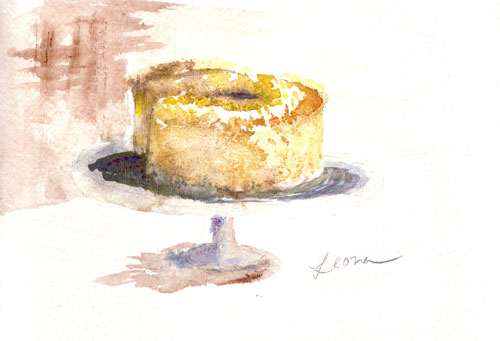
I got two endearing comments last night on my sponge cake recipe (or Esther Robfogel’s z”l recipe) that I posted two years ago:
Esther G. Robfogel (1904-1997) was my mother. I ate her excellent sponge cakes on Pesach and throughout the year for many decades. I hope that my granddaughter, Esther F. Robfogel, will carry on the tradition.
- Nathan J. Robfogel
I’m Esther Robfogel’s daughter. Although I used to bake with my mom, baking was never my forte. As it happens, I was thinking about making mom’s cake this year. After reading your blog, I know I will. Thanks.
- Hanna
On a sad note, two men in Teaneck, New Jersey died walking home from shul at the end of Shabbat when a tree fell on them. I can’t imagine what Pesach is going to be like for those two mourning families.
Leaving Egypt, drawing by my son won Honorable Mention 2006 Passover Art Contest
What is your favorite part of the seder?
Here are some choices (or tell your own):
Many of my family members love a good discussion. They like to bring up new ideas, relate it to what is going on in current events, tell a story of a great rabbi’s seder or a word of Torah they heard from their rabbi.
Acting out parts of the seder story. My personal favorites are walking around the table with my daughter, pretending we are the Jews coming out of Egypt (Avadim Hayeenu – we were slaves). We also like tossing plastic frogs and cattle on the table as we recite the ten plagues.
The food. Either eating matza, which you may have not eaten for a month, or eating the bitter herbs or the parsley and potato dipped in salt water or the korach sandwich (my favorite food ritual) or the ritual egg. Or whatever is served for dinner.
If you are not Jewish and/or you have never been to a seder, I wonder what you think of all this. What would be your favorite part? Feel free to comment.
The potato leek part is my older daughter’s favorite soup, and we make that quite often, and she prefers it without any milk or cream. Both kids love the novelty of having the green star in the middle, and they actually eat the spinach (swirling it with the soup to dilute the taste). I think the spinach purée alone makes a pretty tasty dairy-free “creamed spinach” side dish, but since I am the only one in the family who likes creamed spinach, I don’t make it unless I am making the soup.
If you don’t have a kosher for Passover cookie cutter, use a cup.
Potato Leek Soup
(makes 10 servings)
Ingredients
3 leeks
5 tbsp olive oil
2 pounds white potatoes, chopped
2 qts water
Salt and pepper to taste
½ cup cream or milk (optional)
Cooking equipment
Cutting knife
Colander
Spatula
Measuring cup
Measuring spoon
Large pot
Cookie cutter or small plastic cup with the bottom cut off
Blender (stick blender works nicely)
To make the plain potato leek soup:
1. Discard tough part of green tops of leeks, then wash bottoms thoroughly
2. Cut leeks into thin slices and rinse in colander.
3. Cook in olive oil until leeks are soft – about 5 minutes.
4. Add potatoes and water and bring to a boil.
5. Lower heat and simmer for 30 minutes or until potatoes are soft.
6. Puree with a blender.
Add salt and pepper to taste. For a creamier variation, add ½ cup of cream or milk
Spinach Purée
1. Blanch 1 lb of baby spinach (Put in small colander and submerge briefly into boiling water until barely cooked. Then transfer to bowl of ice water.)
2. Drain spinach.
3. Puree with ¼ of batch of potato leek soup.
Assemble final soup by placing the cookie cutter in the bottom of a soup bowl. Spoon spinach puree into the cookie cutter to desired depth. Pour potato leek soup around cookie cutter to the same depth. Then remove cookie cutter and repeat in another bowl.
Bake the squash in the oven for at least an hour or until tender. Cut it in half. Take out the seeds. Scoop pieces of the squash to mix with the stuffing (I didn’t do this, but I wish I did). Saute the onion until translucent. Add chopped mushroom and celery; continue cooking until soft. Mix in matza, thyme and bits of squash. Stuff it in the squash. At this point, you can bake it in the oven. However, what I did was put it on the warming tray for 3 hours. Serves two.
• • •
In other news, please enjoy this week’s edition of Haveil Havalim, brought to you by the Real Shaliach. Mother in Israel will be hosting the Kosher Cooking Carnival on her blog this coming Wednesday, April 22. That is why I am taking out the time late on Sunday night to type all this up instead of relaxing downstairs with my husband. When I hit Publish, that’s where I am headed. Have a good night!
That’s my new mantra: Passover is fun, Pesach is fun, Passover is fun, Pesach is a blast, Passover is fun (repeat 10 times fast until you believe).
Harriet G posted a link to this video on Twitter last night, and I thought you might get a kick out of it. We are not Sephardim, though we are Sephardophiles (we go to a Sephardi synagogue), so I can’t attest to any of the validity of the suggestions. I do know that I am allowed to kasher my granite as shown but not my formica. And every year I do so water spills all over the place and gets into all sorts of nooks and crannies. Didn’t I say: Passover is Fun!
When I was a kid, it was my favorite holiday. I loved the matzah brie: matzah soaked in egg, then fried in butter. Thankfully, my kids love that dish, so I make it over and over and over again. They don’t miss cereal much if there’s matzah brie.
We have fun with our bag of Makkot, the ten plagues. I should make sure we have all the pieces. My daughter will not be the youngest this year; my two little grand nephews will be in attendance as well! Not sure if they will be up for the sederim. But I bet they will enjoy throwing pieces of styrofoam around for hail, the plastic frogs that we have for the frog plague, and the creepy skeleton that represents the tenth plague, Makkot Behorot, the death of the firstborn.