It’s cold and grey outside. We have no snow, but it has been wintry cold. Maybe you will enjoy my new garden show?

I confess that I stayed up last night working on this slideshow. And then some more time early this morning. Is this how a mom with three kids spends her “free” time? Well, that’s my habit, anyway.
So for those of you who like the technical details, I did this in Actionscript 3. The pictures are all external to the Flash (.swf) file. They are listed in an XML file, as are the captions, so if I feel like adding or subtracting one more pictures, I don’t have to touch the code. It worked fine on my computer, but then when I uploaded it to my web server, not too surprisingly it needed a preloader. I put in the most basic preloader I could find. That’s those little numbers (and “images coming…”) you may see on the screen before the winter pic comes on.
So here’s a list of stuff I might add if I wanted to continue with this project:
1) fancier preloader
2) something more interesting at the end than “the end”: menu? redo? “the end” typewriter style? a fade out?
3) fun with tweens — meaning fancy effects
My last attempt with tweens in Actionscript 2 didn’t go so well. Some of the tweens worked, but some failed in Firefox, for some reason that I will probably never know since I am now delving into AS3. I do hope I get some mastery over AS3 before AS4 shows up.
4) Maybe get that frog that I drew really quickly for Parshat Vaera to jump through the garden? Or let the user control how it jumps? Or hide the frogs in one of the pictures and see if the user can find them? Time to do some more skill building…
All the photos are taken by me of my garden, except the tulips are from my neighbor’s yard.
My 5 year old daughter and her friend’s reaction? Beautiful pictures, but boring.
Well, I gotta learn some more Actionscript 3 before I do anything terribly interesting with it.
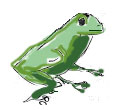 One morning when Paro awoke in his bed
There were frogs in his bed, and frogs on his head
Frogs on his nose and frogs on his toes
Frogs here, frogs there
Frogs were jumping everywhere.
(Frog is drawn by me…a quick sketch with the pencil, then scanned into the computer and the greens were added in Photoshop.)
This post is dedicated to my dear friend Heidi Rosen and her mom, z”l (may her memory be a blessing). Hamakom yinachem otah b’toh avlai Zion v’Yerushalayim…
Heidi’s mom died after a long battle with cancer. This is also for all dear moms and daughters everywhere.
 Lori at Lori’s Earth Friendly Products has been hard at work redesigning her home page. Who says the mom and pop store is gone? Sometimes you just have to know where to look. Lori is a local Highland Park resident who has been selling juice with fiber for kids and other kosher, healthy products from her internet website for many years (and that’s just her part-time job!).
Bought some coffee last week from Lori’s, and I’ve been enjoying every drop of the fresh coffee I’ve made with it.
Did my first WordPress upgrade this morning. It went without a hitch (yippee!).
Contemplated getting rid of most of the categories for blog links and sticking the majority under “More Blogs”, with Highland Park Blogs still existing. Decided to leave as is for now. Hint: two of the bloggers under “Jewish Blogs” are also Highland Park residents, but they don’t blog much about our borough.
I plan to post a text-based virtual walking tour of Highland Park soon. Meanwhile, be sure to visit the environmental virtual tour. I started redoing that start page of the tour in Flash, but I was two-thirds of the way done and got interrupted by my paid work. When I finally had time to get back to it, Actionscript 2 had been replaced as the standard by Actionscript 3. So I haven’t had the energy to get back to that project yet.
Arnold Clayton Henderson, the wonderful writer of Highland Park Environmental News has been away, but I did find out that Edison’s Triple C Ranch is holding their annual CBC today. Birding is popular in this area!
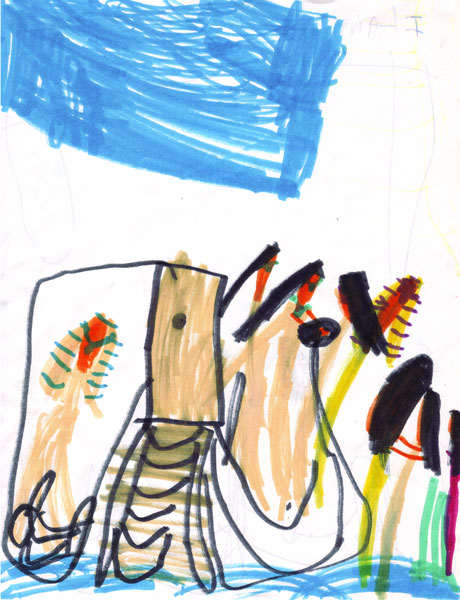
“Shemot is the best parsha in the universe!” declares my daughter. And no wonder…it’s action-packed, with women heroes, defiance of a totalitarian dictator, and the Children of Israel enslaved, but not for long. For her, the best part is how little Moshe is taken from the water by the daughter of Pharaoh. Miriam is standing nearby, and the daughter of Pharaoh’s servants are close by as well. Miriam will soon get her mother, Yocheved, to come nurse her own baby. See my daughter’s rendition of this event by clicking on the thumbnail.
When Moshe is born, Yocheved sees that he is “good”, ‘ki tov’. Aren’t all little babies good? Rashi explains that when he was born, the whole house filled with light. Rashi is referring to a midrash that it was supernatural sign, and therefore she hid him. He is alluding to the light from Breishit, where it also says ‘ki tov’, and it was good.
In his book Exploring Exodus Nahum Sarna points out the language here is not only an echo of Breishit, but later, when Yocheved places Moshe in a basket, it is called a ‘tevah’, echoing the language of parshat Noah.
These two literary allusions tie the book of Shemot (Exodus) back to the book of Breishit (Genesis). Just as God created the World, so He is the one who saves Moshe and will take the Children of Israel out of Egypt.
Sarna writes further about the word ‘suf’:
The container that held the infant Moses was placed among the “reeds”, in Hebrew suf, a term borrowed from the Egyptian for “papyrus/reed thicket.” The idea of the mother was to make sure that the infant would not be carried downstream. It may well be that the rare word suf has been selected in the present text because it is allusive, prefiguring Israel’s deliverance at Yam Suf (Sea of Reeds).
And for your listening pleasure, be sure to check out Ka Ribon by Pharaoh’s Daughter.
 No, this is not a post about the importance of eating your veggies (although you probably should). It’s about the huge amount of waste produced from those styrofoam take-out containers. It’s a real pet-peeve of mine and I actually go so far as to bring my own containers! The wait staff usually rolls their eyes, but I think it’s worth it.
One day a few weeks ago I went out to lunch with a friend and forgot my container. I had a half a sandwich left and asked the wait person to please just put it in a piece of foil because I don’t want styrofoam. Well, they put my little half of a sandwich into a huge container and in a plastic bag!
As I was leaving, I felt the urge to talk to the manager. I didn’t want to get the individual waiter in trouble, but wanted to ask about alternatives to this wasteful practice. The hostess looked at me like I had two heads as I explained my environmental concerns. Then the manager came over and told me he was concerned about this topic and would talk to corporate.
I don’t know if he really meant it, but I was glad I did it anyway. Maybe if more people brought it up, things could slowly change. Until then, I hope that people consider bringing their own reusable containers and withstand the eye rolling and blank stares. It’s many people making little changes that really can make a difference.
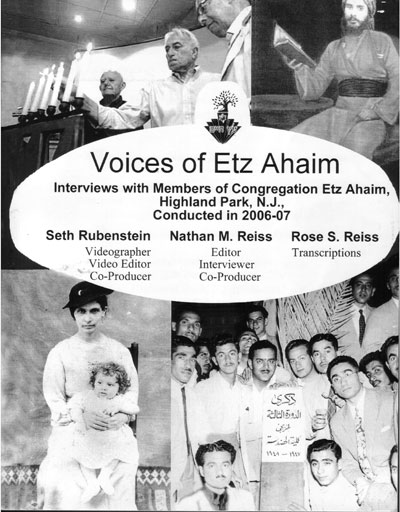
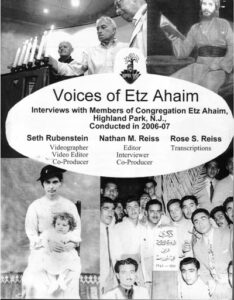 Attention local history buffs! Here’s a book you won’t want to miss:
Voices of Etz Ahaim. Nathan Reiss and Seth Rubenstein paired up to create a wonderful collection of biographies of many of the diverse congregants of Congregation Etz Ahaim, a Sephardi Orthodox synagogue in Highland Park, New Jersey.
Learn about how Rabbi David Bassous was born in India, grew up in London, became a rabbi in Israel, had his first pulpit in Vancouver, and then came to Highland Park. Liselle (Elisheva) Badache grew up in war-torn Algeria. Behzad Hakakian, brother of Roya Hakakian, speaks of growing up Jewish in Iran. One of the oldest members of Etz Ahaim, Al Benzilio, whose parents were from Salonika, reports on the original building in New Brunswick, and how the synagogue was named after one in Salonika.
Pictures enhance each of the biographies. Twenty two people of varying ages and backgrounds were interviewed for the book.
The book was available via the Etz Ahaim website, etzahaim.org; you can probably contact the webmaster to see if you can still get a copy. There is one copy in the reference section of the Highland Park Public Library.
Hear ye, hear ye! What was your favorite Highland Park story of the year?
The Highland Park Mirror is asking you to vote on your favorite story of the year. Cleverly, these are called the Readers’ Joyce Awards. Must have something to do with Joyce Kilmer.
So, what was your favorite story? The top story for me was the library budget cuts. But I was tempted to vote for the closing of the ‘Y’. All my children attended nursery school there, and we enjoyed swimming in the pool. Now there is no pool in Highland Park! When the Aguda dug a big hole for its new building last summer, some of us remarked how it was about the right size for a community pool. RPRY now has a beautiful outdoor pool for the day camp; couldn’t we women have a women’s hour in the summer, even if it’s just once a week?
A beautiful song is in this week’s parsha of Vayechi. The scene is Yaacov on his deathbed, blessing his grandsons Ephraim and Menashe. Part of the blessing has become a pretty song that parents often sing to children at bedtime.
Translation in English:
“May the angel who redeemed me from all harm bless the youths, and may they be called by my name and the name of my fathers, Abraham and Isaac, and may they grow into a multitude in the midst of the land.”
Transliteration:
Hamalach hagoel oti,
Hamalach hagoel oti mikol ra
yivarech et hana’arim v’yikaray bahem sh’mi.
V’shem avotai, V’shem avotai Avraham v’Yitzchak,
v’yidgu larov, v’yidgu larov b’kerev ha’aretz.
Rashi states that “the youths” refer to Ephraim and Menashe. But I like to think of the youths as any kids that are in the room at the time the song is being sung.
For a hilarious post on how someone argued that children are supposed to get into trouble, because after all, the angel isn’t preventing the children from harm but redeeming them, see Maggid of Bergenfield.
For a scholarly post on how we Jews don’t usually worship angels, please read Josh Waxman’s post.
This is a continuation of The Golden Compass — Dust
I am pleased to say I could find no relationship between the Jewish concept of dust and Philip Pullman’s Dust. First, more on Philip Pullman’s Dust: it seems that there is some similarity between Pullman’s Dust and Buddhism’s dust. And Pullman will be producing a new book called ‘The Book of Dust’.
And now, back to Breishit for some thoughts on dust or afar(עָפָר):
Rav Frand has a post on the simile of dust :
The blessing of “k’afar ha’Aretz” represents the history of the Jews. Everybody tramples over the dust of the earth, but in the end the dust of the earth always remains on top. That same dust ultimately covers those who trample it.
One can read about Adam being made of clay, which is originally made of dust but then formed to become man in this post on Parshat Breishit:
Man was formed of the dust of every place on earth, and then kneaded into clay—whereas dust is diverse, yet uniform, clay is united.
Balashon has a post on the etymology of the word ‘Africa’, the source of which may be the word ‘afar’.
There is a Jewish concept called ‘avak lashon hara’, or the dust of evil language, but this uses the term avak and not afar. Avak lashon hara generally refers to traces of talk that may incite lashon hara, such as saying excessive praise.
Finally, on this Kol Torah post on Parshat VaYechi, Doniel Sherman explains how “For you are dust and to dust shall you return” refers to burial, in reference to Yaakov’s burial.
