I am trying to get my daughter to do her homework without my help. Except she won’t even start it unless I am sitting next to her. In an effort to pay as little attention to her as possible while she worked, and noticing a lot of RED, I took photos of her and her environment.
Necklace of beads in a cup holder in my car
The Thursday Challenge photo from last week was of a junk-jewelry necklace belonging to my daughter that seems to have found a “home” in the cup holder near the driver’s seat of my car. I looked at my camera settings for the two photos, and the only difference seems to be shutter speed, 1/40 for the experimental and 1/50 for the boring, shows you exactly what it is photo.
Since last week I posted a gazania flower, this week I am featuring a gaillardia (also known as a blanket flower), taken at the same farm back in September.
Today’s Flowers is hosted by Luiz Santilli Jr. Thank you, Luiz, for this lovely and fun meme.
Why mention Elisheva’s brother? (and who is Elisheva…)
Why the Nile? Why was the first plague on the Nile?
1) Elisheva, who married Aaron the brother of Moses, was the brother of Nachshon Ben Aminadav. Why mention her brother? Because when you get married, you should check out your future wife’s brother (according to Rashi). So my husband said to my sons, he checked out my brother before marrying me, that’s how he knew he would have sons who love computer games. To which my middle son said, “And chess, too!”
2) Nile:
Raizy came up with a good answer:
Why was the first plague on the Nile? It was mida k’neged mida (direct retribution). The Egyptians threw newborn Jewish boys into the Nile, so now the Nile is being used to punish them in return.
Her second answer is similar to the one Rashi gives in 7:17 — the Egyptians worshiped the Nile, as the Egyptians were dependent on the rise of the Nile to water the land, as rain did not fall in Egypt. So God struck their deity.
Raizy adds: “So turning the holy water of the Nile into blood demonstrated that the God of Israel is more powerful than the gods and sacred places of Egypt. It was meant to instill fear and awe.”
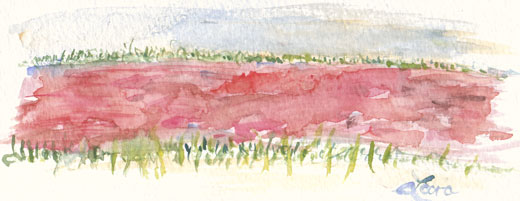
Another answer is found in the Rashi of 8:17 with an aggadic story: God came against the Egyptians following the tactics of the wars of kings, in the order of measures a kingdom takes to when it lays siege to a city. At first it ruins the city’s springs of water (bloody Nile, as shown in the watercolor above). Afterwards the besieging forces sound and blow shofars at the inhabitants of the besieged city to scare them and confuse them. By the same token, the frogs croak and make noise, etc., as it says in Midrash Rabbi Tanchuma. The shofar blasts are followed by hails of arrows, comparable to lice. Then foreign mercenaries are sent in, like the mixture of wild beasts. The pestilence corresponds to a mass seizure of captives. This is followed by an attempt to burn the enemy out — the boils. The hail is like a bombardment of catapult stones. Next comes an attack by a large army (locusts). If the enemy does not surrender, they are held in prison (darkness). If the enemy is still not vanquished, its leaders are executed — the killing of the firstborn.
• • •
Here’s one more quicky that I learned from my son: how can you remember how many plagues are in Parshat Vaera and how many are in Bo? (hint: if you know gematria, that helps. Gematria is adding Hebrew letters as if they are numbers. So aleph is one, beit is two, and so on).
A reminder: just as we empty drops of wine on Passover because we are not allowed to rejoice over the death of the Egyptians in the sea, we are not allowed to enjoy the suffering of our enemies, even if they have created pain for us.
Ratatouille, a traditional French Provençal stewed vegetable dish
Ilana-Davita has hosted her first Kosher Cooking Carnival, and she named it the “Green Edition” because it is mostly meatless recipes and because it is almost Tu B’Shevat, the holiday of the trees. I thank her for including my matzo ball recipe and my ratatouille.
Looks like Tu B’Shevat will occur this year on Monday, February 9th. Maybe I’ll do a little collage of tree photos in honor of the day. It was always strange to me, growing up in snowy cold New England, that one celebrating the planting of trees in February. But Israel has a much different schedule than here, so I suppose February is a good time there to plant a tree!
Speaking of matzo balls, my middle son (he’s twelve) made the matzo balls on Friday. I dictated the recipe to him by heart, as I was rushing off to take a shower about an hour before Shabbat. When he asked “how much oil,” I yelled, “some.” The matzo balls came out absolutely delicious. When I asked him how he did it, he claimed he “worked the balls a lot.” Which is sort of the opposite of conventional wisdom on how to make a good matzo ball. He also made a “chocolate chip pie” using a muffin recipe cooked in a round pie tin. That got devoured, too. And I had enough time to make my cole slaw with red and green cabbages, brussel sprouts and garlic spread.
“EXPERIMENTAL” (Interesting Photographic Effects, Failed/Strange Photos, Blurry, Overexposed,…)
(any guesses on what this is? I’ll post a “clearer” photo next week.)
I was away with my family since Monday, but I did have time to read over the parsha questions I receive in email each week. Maybe you can guess some answers for these two:
Why the Nile? Why was the first plague on the Nile?
Why mention Elisheva’s brother? (and who is Elisheva…)
If you know any of the answers, feel free to comment. If you don’t, take a guess! I’ll post Rashi’s answers early next week.
Sky Watch Friday is a photo meme with photos of sunrises, sunsets, blue skies, gray skies, pink skies, dark skies and any other kind of sky posted by bloggers all over the planet.
I took these photos of the American Sycamore trees on my block at sunset one day.
I consulted with my local tree expert, and she thinks these trees outside my office window are American Sycamores. There seem to be quite a few in Highland Park.
I was attracted to them because of the round seed balls.
The above is a photo of the seed ball, before we got white snow now gracing Highland Park.
The trunks have this distinct peeling bark. This particular tree is on Abbott Street.