I took a photo of this flower in September, and I would love to grow it in my garden. It looks a lot like gaillardia, but those don’t seem to have stripes like this flower. I believe it’s a gazania (thank you, Sara!) in the asteraceae family.
Today’s Flowers is hosted by Luiz Santilli Jr. Thank you, Luiz, for this lovely and fun meme.
Sky Watch Friday is a photo meme with photos of sunrises, sunsets, blue skies, gray skies, pink skies, dark skies and any other kind of sky posted by bloggers all over the planet.
Last week I noted two wonderful Sky Watch posts: Guy in Regina and Carletta in West Virginia. Guy wrote: “I’m sure glad I had my camera while I was driving down Lakeshore Drive…” and Carletta said: “As I look through the branches of the big old oak tree often I catch a glimpse of the sky and know a sunset I wouldn’t want to miss is about to happen. Traces of pink in this image were enough to make me grab my camera last Thursday as I was looking at Sky Watch posts and head outside.”
I wanted to share with you a bit of how I get photos. Two of my three kids take art classes across town with Jill, so I’m often driving from the North side of Highland Park (where I live) to the South side (where Jill lives). It seems that this driving is often around sunset (at least in winter). So on the particular day that I took these photos, I had a few minutes before I needed to pick up my daughter, and I headed over to the high school to see the cupola (see above) and its sky. On my way, I captured the moon (see top photo).
I enjoyed the pinks and blues on top of the high school, but I realized that I had to rush to get my daughter on time.
On my way in my car to get my daughter I need to cross Raritan Avenue. I photographed the above while waiting for the light to change. You can see by the upper right of the photo that I’m taking this through my windshield.
Once my daughter was in the car with me, we re-crossed Raritan Avenue. A quick glance down Raritan toward the river and New Brunswick displayed a powerful, colorful sunset. But I decided to head over to the back of the high school with my daughter. This is what I caught in the back.
Here’s my six-year-old daughter’s contribution to this post (she took this picture).
In contrast here’s how the high school and cupola looked this morning during a brief snowfall.
Painted Sewer Pipe Makeshift Bomb Shelter in Nitzan
I follow a lot of Israeli blogs (Anglo Israelis, they write in English). I wanted to share a few recent posts. The above photo is from Shiloh Musings; Batya has invited Sara Layah Shomron who lives in the south of Israel to write about her experiences. She used to live in Gush Katif, which is in Gaza, but since the expulsion from Gaza (which was supposed to bring peace), she and her family have lived in Nitzan. As they have no bomb shelter, these large sewer pipes have been set up as makeshift bomb shelters. Sara Layah writes: “The scenic and calm view [on the sewer pipe] was beautifully painted by our neighborhood youth.” She describes being interviewed on the phone by a reporter in Orange County, California and needed to relay: “I hastened to say, “I’m not being rude; rather, have 30 seconds to run to the sewer pipe.” Read more of Sarah Layah’s post.
• • •
ALN often writes about art therapy, working in a hospital, interactions with her kids and “keeping the balance”. On one recent post she talked about the effects of the war:
Shoilem Aleichem (via Joseph Stein’s screenplay) put it best in our favorite classic, Fiddler on the Roof:
Townsperson: Why should I break my head about the outside world? Let the outside world break its own head….
Tevye: He is right…
Perchik: Nonsense. You can’t close your eyes to what’s happening in the world.
Tevye: He’s right.
Rabbi’s pupil: He’s right, and he’s right. They can’t both be right!
I come from Sderot, the city in Israel that for eight years has been terrorized, by 10,000 rockets fired against us from Gaza.
As a law student, I learned – and I believe – that all human beings have the right to peace and security.
But when I see today’s resolution, I ask: Why is the United Nations ignoring my suffering? When the terrorists committed these 10,000 violations of international human rights and humanitarian law, why was the UN silent?
Are human rights for some, but not others?
The constant assault on Sderot has destroyed our ability to lead a normal life. The warning before each attack gives us only 15 seconds to run for shelter. Fifteen seconds that will decide, life or death.
Mr. President, who will protect our right to life? My family does not have a bomb shelter, so we run to the most protected room, which is the shower.
If you want more information about the war in Gaza, the best place to start is the Muqata. Then visit Jack for some more links.
Thursday Challenge theme for this week is “MANY” (Lots of People, Lots of Space, Lots of Things: Buildings/Candy/Toys/Animals, Countless,…).
I took many photos of the books in our living room and dining room before choosing these children’s books that were hanging around on a shelf of a bookshelf that badly needs replacing. See anything familiar?
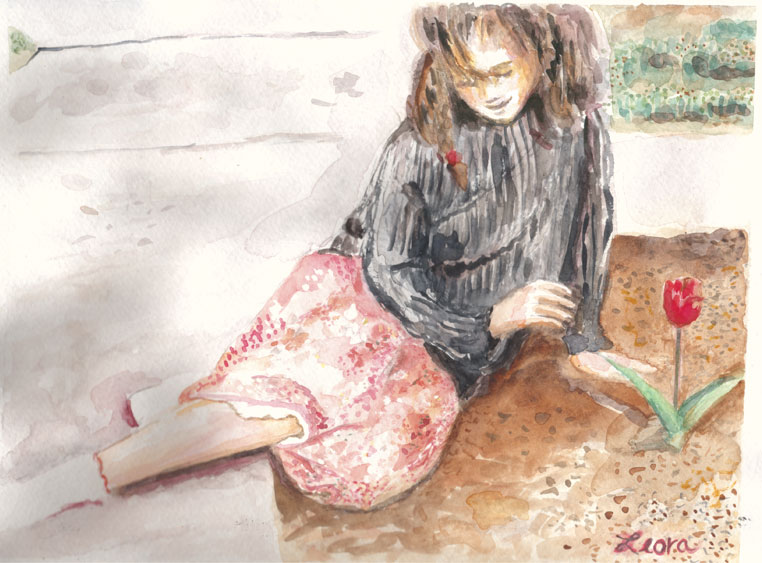
Girl with Tulip, watercolor on paper, 2009
I worked on this last week and the week before. I worked on another one in between my study of a girl with tulip and this one. This one came out brighter and less muddy. There are still pieces about it that bother me, but I’ll keep my mouth shut. Click to enlarge.
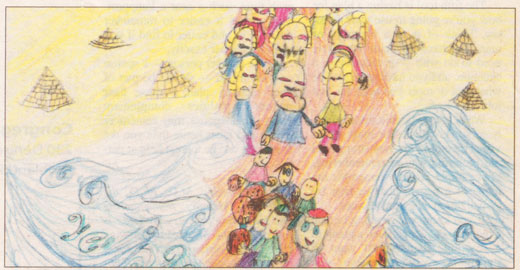
Leaving Egypt, drawing by my son, won Honorable Mention in 2006 Passover Art ContestThis week the parsha is no longer features the family stories of Abraham, Yitzchak, Yaakov and Yosef. The tone of the text changes, and the focus is on a group of people in slavery, leaving Egypt and nation-building.
Robert Alter writes in his Translation with Commentary: The Five Books of Moses:
As the long historical narrative of the Five Books of Moses moves from the patriarchs to the Hebrew nation in Egypt, it switches gears. The narrative conventions deployed, from type-scenes and thematic keywords to the treatment of dialogue, remain the same, but the angle from which events are seen and the handling of the characters are notably different. Genesis ended with death, and the distinctly Egyptian mummification, of Joseph. Exodus begins with a listing of the sons of Jacob who came down to Egypt, thus establishing a formal link with the concluding chapters of Genesis in which a more detailed list of the emigrants from Canaan is provided…Instead of the sharply etched individuals who constituted a family in all its explosive dynamics in Genesis, we now have teeming multitudes of Israelites whose spectacular prolificness introduces to the story the perspective of the whole wide world of creation announced at the beginning of Genesis: “And the sons of Israel were fruitful and swarmed and multiplied and grew very vast, and the land [הָאָרֶץ same word as in Genesis] was filled with them” (Exodus 1:7).
Nahum Sarna in Exploring Exodus explains the title:
It is called in English “Exodus,” a title derived originally from the Septuagint, the Greek translation made for the Jewish community of ancient Alexandria in Egypt. It is abbreviated from a fuller title “The Exodus of the Children of Israel from Egypt,” which in turn reflects a Hebrew title current among the communities of the Land of Israel. The most widely used Hebrew name is Sefer Sh’mot (“The Book: Names”), taken from the opening Hebrew words of the book, “These are the names of the sons of Israel.”
Here’s how Sarna connects Exodus to its predecessor Genesis:
The narratives in Genesis focus upon individuals and the fortunes of a single family; they center upon the divine promises of peoplehood and national territory that are vouchsafed to them. In the Book of Exodus, the process of fulfilling those promises is set in motion…God’s commissioning of Moses at the scene of the Burning Bush directs him: “Go and assemble the elders of Israel and say to them: the Lord, the God of your fathers, the God of Abraham, Isaac and Jacob, has appeared to me and said “I have taken note of you [Heb. paqod paqad’ti] and of what is being done to you in Egypt…'” This is a studied echo of Joseph’s dying words “God will surely take notice of you [Heb. paqod yiphqod] and bring you up from this land to the land which He promised on oath to Abraham, to Isaac, and to Jacob.”
In the previous parshiot, the ones of Breishit, we got to know the characters well. In Shmot, we still can learn from the people presented in the parsha, such as the daughter of Pharoah, but I feel more distance. Perhaps we can see the upcoming parshiot as a bridge from character portrayal to nation-building and the giving of the Torah in the middle of the Book of Shmot.
Do you find transitions hard? How do you see the change from the Book of Breishit (Genesis) to the Book of Shmot (Exodus)?
or Rat-Tat-Too-Eeee as it is pronounced and affectionately called
I enjoy making this delicious, warming dish in the cold winter months. You may also serve it at room temperature.
Ingredients:
1 medium sized eggplant (see note below for substitutes)
1 onion
2 cloves of garlic
2 zucchinis
some mushrooms (optional)
some red wine (or substitute tomato juice or broth)
1 can tomatoes (or use fresh ones if available)
optional herbs: parsley, basil (I don’t usually have these in the winter)
optional hot stuff: hot pepper (jalapeno), hot pepper sauce, or schug
olive oil
Note: if you don’t like eggplant or you don’t eat nightshades, you can use squash, yam or sweet potato instead. The taste is a bit different, but it is delicious all the same.
Cube and stir fry the eggplant in olive oil in a large-bottomed pan (I use a wok-like pan). Alternatively, you can bake the eggplant whole, especially if you have the oven on for other dishes. Then chop the baked eggplant and add after the onions are sauteed. Take the eggplant out of the pan and put aside. Chop and sautee the onions and garlic in olive oil and cook until translucent. Add the mushrooms. When the mushrooms soften, add sliced zucchini and a bit of red wine or other flavorful liquid. Add the cooked eggplant and cover. When the zucchini has softened, add the tomatoes and herbs. May be served warm or at room temperature. Easy to re-heat.
More on nightshades (though I don’t know how you could make this without tomatoes)
Speaking of ratatouille, did any of you see the movie? I thought it was OK, but when it comes to mouse/rat movies, I really preferred the recent The Tale of Despereaux. Anyone see that one or read the book?





 Last year:
 Anyone see that one or read the book?


