About to go on a little journey by horse around Cold Springs Historic Village
Can you think of any famous journeys? I asked some friends, and we came up with these:
Journey of the Children of Israel from Egypt through the desert to the Land of Israel
Travels of Christopher Columbus
Explorations of Magellan, Sir Francis Drake, Lewis and Clark
Donner Party
The band Journey
The Travels of Benjamin of Tudela
Man’s travel to the Moon
Other space expeditions, like the tragic Challenger trip
Journey to the Center of the Earth
Exodus by Leon Uris
Marco Polo, Jacques Cartier, Vasco de Gama, Captain Cook
Commute to New York City every day
Odysseus, Jason
Hegira, the flight of Muhammad from Mecca to Medina in 622 A.D
Byrd, Peary, Scott and Amundsen: journey to the Poles
Laura Ingalls Wilder – journey through the places she lived in the U.S.
Dorothy’s journey to Oz (and back to Kansas)
Bilbo’s and Frodo’s journeys in Middle Earth
Finding parking in New Brunswick, New Jersey
On the Road, by Jack Kerouac
Midnight Ride of Paul Revere
After 1948 many Jews fled Muslim countries – most went to Israel, some to France and to the U.S.
Journey of the 12 spies into the Land of Canaan/Israel
Around the World in 80 Days, Jules Verne
Pilgrims travel to America (as did later many others from Europe and elsewhere)
Lady Godiva’s 11th century ride through Coventry to protest her husband’s excessive taxation of his subjects
In this week’s parsha of Lech Lecha, God tells Avram (he is not yet Avraham) to go forth from the land of his birth and travel to another land. According to the commentator Rashi, one is liable to lose three things by journeying: a trip can inhibit the birth of children, decrease one’s wealth and lessen one’s fame (lose one’s reputation). So God blesses Avram accordingly so he will have many children, wealth and he will become a great nation (fame).
So do any of the famous journeys we mention fit into the three categories mentioned by Rashi? As a loss or as a gain? Can you think of any other well-known journeys? Do people lose children, wealth or reputation on these journeys? Or do they gain them?
So, 13 years ago my little guy came out like a cannon ball. No time for the doctor to show up, no time for the epidural. The nurses were in a panic; they thought they would have to deliver the baby (a resident at the hospital did). There’s a technical name for women who deliver babies very quickly. I can’t remember it – I just call it “cannon ball pain.”
And then the parsha (portion of the Torah reading) tells me that I’m going to deliver in pain. No kidding.
At least it wasn’t emotional pain, like that of losing my mother. Her yahrzeit (anniversary of her death) is tonight.
We are in the middle of celebrating the holiday of Sukkot, in which observant Jews around the world eat (some sleep) outside in little booths called Sukkot (singular = sukkah). With my son’s guidance, this post will teach how to create a sukkah decoration (recipes vary wildly from family to family – there are no set traditions for decorations).
Ingredients:
1 creative, artistic mind
paper
1 box of markers
1 pencil for initial sketch
Clear contact paper for laminating
First my son drew the initial sketch with pencil. Then he painstakingly colored in the drawing:
The spaceships have no religious significance. The Hebrew says “Brukhim Ha’Baim” – Welcome to All Those Who Come, which is a common greeting to put at an entrance to a sukkah. You can see those words on the front of our sukkah at the bottom of this post.
When the drawing is complete, one cuts some clear contact paper slightly bigger on all sides than the drawing. Then one cuts one more piece of contact paper the same size as the first. Carefully peel off the backing and place the contact paper on both sides of the drawing.
Here is the drawing hanging in our sukkah. There are also a lot of red apples in the sukkah; my son made a game for our guests of “count the apples” – he claimed we had 50 apples pictured in the decorations.
Here is a photo of the sukkah from further back. Unfortunately, this may be the last year of this sukkah. My husband says it takes too long to put up (he created it himself), and it is also not big enough for hosting guests. So we may get a new one, probably a pre-fab that is easier to put up.
Many of the piyutim (liturgical songs) that we sing at Congregation Etz Ahaim on Rosh Hashana and Yom Kippur are beautiful, memorable melodies, but one that stands out in particular is Et Sha’arei Ratzon (see the piyut on Sefaria). The poem was written by R. Yehuda ben Shmuel Ibn Abbas in the 12th century; it is a haunting retelling of the Akeida, the story in which Avraham brings his son Isaac as a sacrifice and then he is stopped by an angel. The repeated verse that most remember is “Oked veHanekad VeHamizbeach” – “the binder, the bound, and the altar.” Here is Avraham the binder bringing his son the bound on the altar – a scary, hard to explain, difficult to comprehend episode in the Torah. It seems like we too on Rosh Hashana are coming before God; like for Avraham, it is the “Et Sha’arei Ratzon” – the time of the gates of grace or desire. The Akeida is part of the Torah reading for Rosh Hashana.
My husband explained some of the midrashim of this song. The first is a lie that Avraham tells Sarah, that he is taking Yitzhak (Isaac), her beloved only son, to study Torah. In the next, Avraham, Yitzhak (Isaac) and his servants are approaching the mountain, but at some point the servants are told to stay behind because, according the English translation in the Sephardi siddur, they are not “spiritually worthy.” The Hebrew, however, calls them Hamor (may possibly be translated as donkey). When Isaac is taken to be sacrificed, he worries about his mother Sarah, how she will weep for him. The angels ask that Isaac be spared, that there shouldn’t be a world without a moon (i.e., without Isaac, who is compared to the moon).
The poet, who starts the poem with gates of “ratzon” (desire?) ends with gates of “rahamim” (pity, mercy) and a call for salvation.
Et Sha’arei Ratzon (Oked Vehanekad), sung at Congregation Etz Ahaim in Highland Park, New Jersey, on Rosh Hashana, is a poem written by R. Yehuda ben Shmuel Ibn Abbas in the 12th century; it is a retelling of the sacrifice of Isaac.
Sukkah 2008; painting of grapes in the corner
Batya has done three blog carnivals this month, and her final one is the 46th edition of the Kosher Cooking Carnival. Some of the highlights include Zwetschgenkuchen, the relationship between solet and semolina, and whether it is better to have insects and or insecticides (I’ll take the bugs, thank you very much – no insecticide for me – soap sometimes can drown aphids, that’s as far as I get). We mostly get bees in our sukkah; I think the nastier bugs have gone South by the time Sukkot comes.
As this coming week is Sukkot, I suspect many of you celebrating this upcoming holiday are (again) meal planning and cooking? What’s on the menu? I’m hoping to make an apple pie, and I also plan to make strawberry cashew pudding (another recipe from Klara). The pudding, if all goes well, will become a post, too.
A new Torah was dedicated on Sunday at Congregation Etz Ahaim, a Sephardi Orthodox synagogue in Highland Park, New Jersey. Sephardim read the Torah with the Torah scroll in an upright position, whereas Ashkenazim read the Torah scrolls placed flat on the bimah (raised platform). So the Torah cases of the Sephardim are made out of fancy metal, and the Ashkenaz ones are typically embroidered cloth.
The happy occasion was in honor of a bat-mitzvah; the bat-mitzvah girl conducted the dedication, along with her grandmother. It was a lovely community affair, and children were in attendance, including some who got rather sleepy (such as my daughter) because the ceremony was happening at their bedtimes. When they brought out all the Torah scrolls, the children woke up, with all the lively singing and dancing.
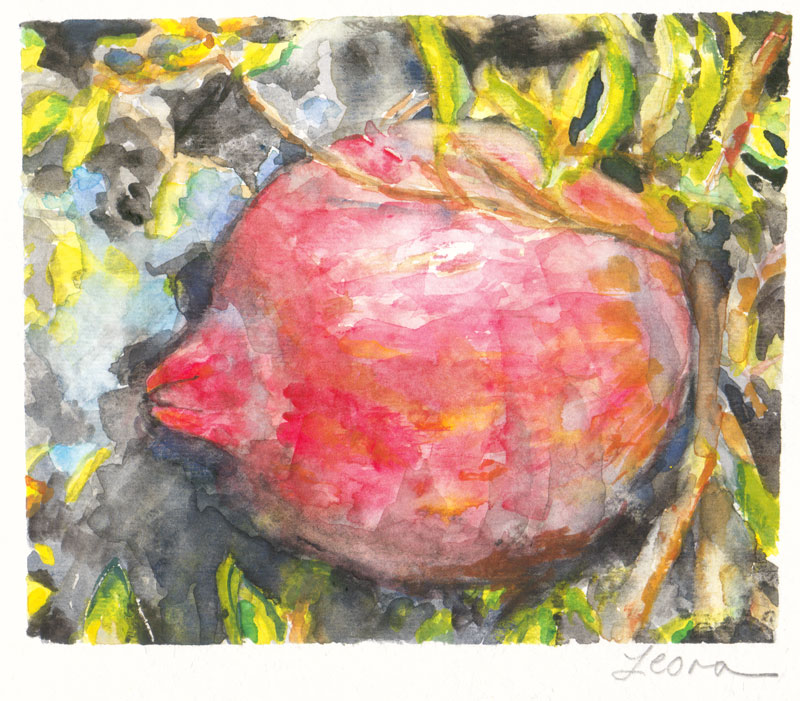
Pomegranate, watercolor on paper, 2008
This is a re-post of my pomegranate painting I did last year. The pomegranate has many seeds; some say there are as many seeds in a pomegranate as there are mitzvot in the Torah (613). Well, years ago, my brother and I counted the seeds of a pomegranate one afternoon. We put the seeds in bowls spread across the table. Then I reported back to the teacher that indeed this pomegranate had way more than 613 seeds. His response: “Did the pomegranate grown in the Land of Israel?” I responded no, as it probably grew in California. Anyway, it is customary to eat a pomegranate on Rosh Hashana, the Jewish New Year. You can read more about the symbols for Rosh Hashana in last year’s post.
For more images with a little red or a little of red, visit Ruby Tuesday:
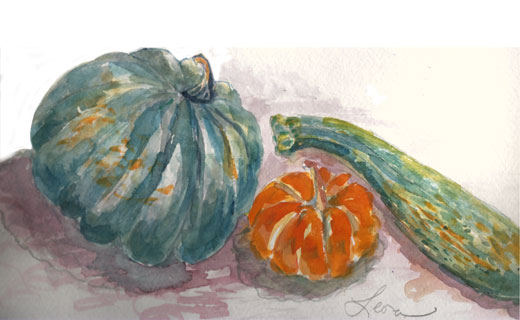
Three Squash, watercolor on paper
This coming week is Rosh Hashana, the Jewish New Year, and it is traditional to put certain symbolic foods on the table (see my post from last year about the simanim). Yesterday I did this watercolor of three squashes (or simply ‘squash’ – looks like the plural can be with or without the ‘es’).
What to do with squash? One of my friends said she will make my squash into a delicious squash soup. Will she share the recipe? Hmm. I could chop up the zucchini and saute it with onions, fresh garden basil and a bit of tomato. The little pumpkin, I told my son, is too tiny for a jack o’ lantern, but I told him we could buy a bigger one for that purpose for Sukkot (holiday in three weeks). I will probably make a stuffed squash for Friday night.
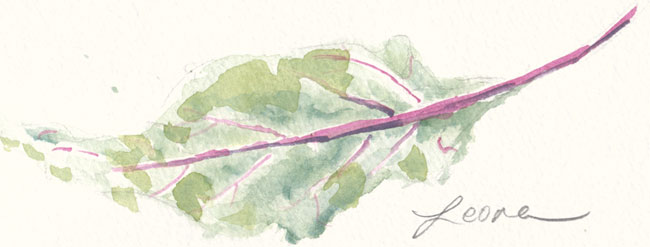
Rosh Hashana is coming next week – for the Jewish New Year, Jews around the world are (supposed to be) preparing themselves spiritually for the day. I approach the upcoming holiday by exploring the simanim, the food symbols that we put on the table. Beets, pictured in the above watercolor, are one siman. More on the simanim next week.
Chalfonte Hotel, Cape May, New Jersey (built in 1876)
While I am waiting patiently for Mary to post her Ruby Tuesday Mr. Linky,
Batya posted the next edition of JPIX (the Blog Carnival of Jewish Photo Bloggers). So enjoy that while you are waiting! The next one will be in December, and I will be hosting, so, Jewish photo bloggers, please photograph upcoming Jewish holiday preparations, especially your sukkah.
I happily award James and James – both are posting beautiful photos.
The first James has recently posted he is thinking of changing his blog name to something that reflects his current interest in walking (“Views from my Walking Shoes”?).
The second James lives in nearby Newtown, Pennsylvania, and I greatly enjoy his collection of photos of familiar and less familiar locations.






 Lorri of Jew Wishes has