Because my white mums are growing right next to a tomato plant (I didn’t plant the tomato plant there; it grew in my flower garden, and I just let it be), I decided to call this post “Summer meets Fall”, with the tomato symbolizing summer the mums symbolizing fall.
A close-up of the same tomato
Here’s a red dianthus, which I bought in the middle of August when it was on sale and I wanted something red in my garden. Wouldn’t it be nice if it survives the New Jersey winter? It was considered an annual, but one never knows.
To participate in Ruby Tuesday, post a photo (or more) with a little red or a LOT of red. Then visit Mary the Teach at http://workofthepoet.blogspot.com/ to submit your link.
Iran protest held outside Mennonite-affiliated store
Denomination was among the hosts of Ahmadinejad dinner
Some 200 members of the Jewish community demonstrated against a Highland Park store [Ten Thousand Villages] whose parent company was part of a group that hosted Iranian President Mahmoud Ahmadinejad that same night.
Ahmadinejad has drawn the wrath of many for his Holocaust denials and his vow to destroy Israel and America.
“While they’re having dinner, we are here protesting,” Jeffrey Schreiber of Highland Park told NJJN. “We want people to know that if they buy from this store they are buying Mahmoud Ahmadinejad dinner.”
I know some of the people mentioned in the article (Andrew Getraer, Michael Gordon and Doniel Sherman), and I can now say I am proud to know them. Doniel also spoke in New York City, along with Elie Wiesel and Natan Sharansky.
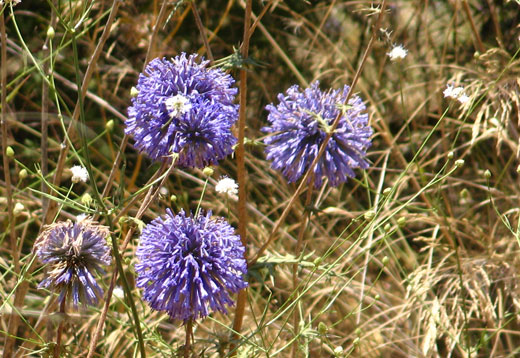
I photographed this daisy-like wild flower growing near a pond across from Lee Turkey Farm in East Windsor, New Jersey. It was a prolific photography day for me.
Note: Fleabane sounds like a good possibility for what this is (thanks, Louise). I think it is a weed. One commenter thought this might be lawn daisies (didn’t look like the ones in Google images, though) and someone else thought asters (and egWow is convinced these are asters). Hmmm…
Today’s Flowers is hosted by Luiz Santilli Jr. Thank you, Luiz, for featuring flower followers who share photos in a fun fashion.
Batya has done a marvelous job of JPIX, a carnival of Jewish pictures. She linked to all my posts on Rosh Hashana by using my Rosh Hashana tag (https://www.leoraw.com/blog/tag/rosh-hashana/ – each post had a picture, as do most of my posts!). However, she had a difficult time with some of the links. Can you help her out by suggesting which pictures need some fixing and how she can fix them? (I found two; the crocs and one of Mordechai’s pics).
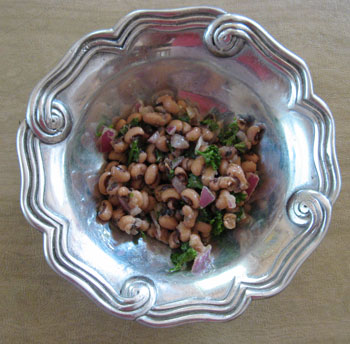
Black-Eyed Bean Salad
I wanted to have all the simanim (food symbols) on the table for the first night of Rosh Hashana. I got really close. I just forgot the dates. Oooops. Only my husband missed them, as he’s the only one who likes dates.
In the past, I would say to my husband a few days before Rosh Hashana, now, what are the special foods we need to get? And he would mention maybe carrots and beets, and we would say a yehi ratzon on the carrots in the soup. When I was growing up, I don’t remember doing the yehi ratzon prayers at all. In fact, my father, who joined us for most of our Rosh Hashana meals, thought we should save the pomegranate for the new fruit, which one does on the second night of Rosh Hashana. My husband pointed out that we had eaten pomegranates within the last year, and one is really supposed to say the shehiyanu, the prayer for something new, on a fruit that one has not eaten in the past year.
So this year, because I did all this research on the simanim (thank you, readers, for your encouragement along the way as I posted various foods), I was the expert.
Back to the first night…so we have all these simanim on the table. With the help of Mimi’s Israeli Kitchen, I made the black-eyed beans (peas?) into a bean salad. She used: “seasoning it with a little chopped onion and a handful of mixed, chopped, cilantro, parsley, and celery tops. Lots of fresh lemon juice, to balance the earthy taste of the peas (which are really beans, but never mind) – salt and white pepper.”
Here’s my bean salad ingredients:
Black-eyed beans, soaked overnight and cooked in a crockpot
Chopped red onion
Chopped fresh parsley
Fresh lemon juice
Some olive oil
Salt and pepper
I was considering making a beet salad (Mimi made one: “some thinly sliced onion, salt, pepper, a little cumin, olive oil, a little sugar, and vinegar”), but as time didn’t allow (I was chaffeuring kids to play dates and art class in between cooking and doing a little of my web work), I just made steamed beets and cut them up.
What to do with leeks? Mimi posted a delicious leek tart (same post); I decided to incorporate the leeks with my chicken soup and with my roasted chicken with apples and mushrooms (I stuck one leek inside the chicken). I had more leeks than I needed, as I bought two sets; the first set of leeks didn’t look so good, and I had to go back to the supermarket on Monday morning anyway, so I bought a fresher set of leeks. The not-so-nice leeks are now resting in my compost pile which will hopefully be decomposed by next spring and will provide a new spot for growing tomatoes.
I made stuffed squash for the k’ra, the siman that can be a gourd, squash or pumpkin. I used Mimi’s stuffed artichoke post for inspiration on the stuffing. Hers had more ingredients; I had chopped meat, onion and spices in mine. I added chopped fresh ginger, too.
For the carrots, I went for simple. I liked the idea of cutting the carrots like coin-shapes.
Do you think I put a fish or lamb’s head on the table? I did the same thing I did last year, which was cut a piece of gefilte fish into the shape of a fish head and use a bit of cooked carrot for the eye.
Finally, I did one “joke” of a siman, which was to steam a “head” of broccoli.
The problem was, it was late, we were all tired, and my eldest son only liked the pomegranate. So after doing the apple dipped in honey (my daughter had us doing this one at every meal), we ate the pomegranate. It wasn’t nearly as juicy as ones I have eaten in the past. I bet the ones in ALN’s backyard taste better.
Next we ate the gefilte fish. Or five out of seven of us ate it. It turns out there is a special yehi ratzon for fish, separate from the “head and not the tail” one — “she’nif’reh v’nir’beh ki’dagim” (that we be fruitful and multiply like fish).
At this point, we just started eating the rest of the meal. Did we say any more of the yehi ratzons? I don’t know, but everything got eaten, at any rate. I enjoyed the meal, and it didn’t last nearly as long as a Pesach seder.
The best view of sunrise from my house is in my backyard. Unfortunately, my backyard has all those wires up there. I decided to learn to live with wires in photos and let them be part of the composition of the photo.
This is where I was for about two hours this morning, at the Friends of the Highland Park Library Book Sale. I volunteered for a little over an hour taking the money from the sales, and then I came back with my daughter to buy some books. Despite the pouring rain, patrons were coming in and buying books. Those running the sale told me that the sale has been a success (they have made over $3000). In the middle of the photo is Mort, who spent a lot of his time this past week putting together the sale, and on the right is George, another sale organizer.
So, what did we buy? I bought a biography of the Rema, the story of Rabbi Moshe Isserles. It says in the introduction that certain liberties where made with re-creating his life, but I think I will get a feel for what life was like in 16th century Cracow. My daughter selected a Mother Goose book (we already own one, but this one has different illustrations), a Berenstains Bears book, and Meet Samantha, an American Girl book. I also threw in a copy of the Princess and the Goblin, thinking at some point my daughter will enjoy this classic.
I’m currently reading Mary Poppins, the original book by P.L. Travers. It is delightful, and one can see how it inspired the producers of the more famous movie. I hope to post excerpts from the book in the next week. But now I need to get back to my holiday preparations.
Lorri writes a beautiful blog called Jew Wishes. Her posts are heart-felt, as well as being well-written. She reviews books, films, cookbooks and gives general information and insights on Jewish topics. I particularly liked her post on repentance (with two film recommendations), where she writes:
Pent up anger and other emotions lead to an unhealthy state of mind, external presence, and physical being, and it distorts our lives. To forgive is also to repent, and to repent includes forgiveness. Repenting for our unhealthy attitude towards another person must include forgiveness for what we feel that person has done in order to hurt us.
As this doesn’t sound like a classical interpretation of teshuva (repentance), I would love to do more research on teshuva and emotions to find out if I can reconcile the traditional approaches with this more emotional approach. Hopefully, more on this topic soon.
It was a nice surprise to wake up this morning to find she had awarded me a blog award! As I have just given out this award to five of my favorite mommy bloggers (attention: ALN, SuperRaizy, JugglingFrogs, Baila, and Hadassah), I’m going to wait until after the holidays before I do anything with this one. But Lorri did have the rules on her post, which I neglected to include, so I’m going to include them here, in case my mommy bloggers feel so inclined to send the award onward ho to some other deserving bloggists:
Here are the rules:
1) Add the logo of the award to your blog
2) Add a link to the person who awarded it to you
3) Nominate at least 5 other blogs (I changed this to five)
4) Add links to those blogs on your blog
5) Leave a message for your nominees on their blogs!
FYI, comments are NOT closed. If you ever see that, it is a mistake. I don’t know how that happens! Please let me know if you see comments are closed on a post.







 Lorri writes a beautiful blog called