Notable Links from the Internet:
The Best Overall:
On Israel:
Art Links:
- Parshat Acharei Mot: Leviticus 16:10 Scapegoat by by William Holman Hunt
וְהַשָּׂעִיר, אֲשֶׁר עָלָה עָלָיו הַגּוֹרָל לַעֲזָאזֵל, יָעֳמַד-חַי לִפְנֵי יְהוָה, לְכַפֵּר עָלָיו–לְשַׁלַּח אֹתוֹ לַעֲזָאזֵל הַמִּדְבָּרָה
“But the goat, on which the lot fell for Azazel, shall be set alive before the LORD, to make atonement over him, to send him away for Azazel into the wilderness.”
This a good example of a pre-Raphaelite school painting.
- Israel Broytman, painter
Famous Bloggers:
From this article:
Male bloggers tend to write about politics, technology and money; women are more likely to blog about their private lives and use an intimate style of writing.
At some point, I may do a post about women bloggers. Especially on how they deal with conflict. If anyone finds any relevant links, feel free to leave them in the comments. Or any of your own experiences with conflict and blogging. (Jack tried to help me find some a few weeks back, but the ones he sent me didn’t seem to fit my idea. Thanks for trying, Jack).
This post is for: Batya
Last night we went to a Yom HaZikaron service at RPRY, my children’s Jewish Day School. The school is in Edison, NJ, which borders Highland Park (it is only an eight minute walk from our home). The evening began with a memorial of the Mercaz HaRav Yeshiva students that died in the recent terror attack. Because my son is in eighth grade, he was part of the ceremony.
The boys entered on one side of the gym holding yahrzeit (memorial) candles; the girls came in on the other side of the gym. In small groups they came up to the stage and told a little of the story of each of the dead students. On the wall behind the stage was a slide show of the each of the murdered students.


Just by coincidence, my son spoke about Yonatan Yitzchak Eldar of Shiloh, where Batya is from. So I dedicate this post to Batya.
My five-year-old daughter startled as they sounded a siren similar to the one heard in Israel on Yom HaZikaron. “What’s that?” she looked up at me. “Shhh,” I replied, “I’ll explain later.” When the siren ended, I explained to her how people in Israel stop for one minute when they hear the siren. To remember the fallen soldiers, I think I said. I don’t know how much she understood, but I tried.
Later, a speaker from Israel who is visiting for a year spoke about the progress and problems in Israel. I missed most of the talk because I went out with my five-year-old. He said he is considered an Israeli in America and an American in Israel (like Batya, he came to Israel 38 years ago). There was also a special ma’ariv service (which I also missed). I was outside talking with some women about the ridiculous choices the New York Times makes for front page news from Israel on Yom HaZikaron (one of the women told the other woman, who had just come off the plane that morning from a visit to Israel, that she shouldn’t be subscribing to the New York Times!).
Happy Yom Ha’atzmaut (Israel Independence Day).
First, because this is a post for the wonderful Kosher Cooking Carnival, two watercolors:

Recently I posted about the health values of garlic. One quality of garlic is if you cook it, it loses much of its pungency and instead becomes sweet. I learned this recipe while standing online at our local Glatt 27(it is called 27 because it is on Rte. 27). The woman in front of me told me she makes this every Friday afternoon. Her kids like it so much they peel all the cloves. No such luck with my children; Eldest Son just looked over my shoulder at this post and called it evil.
Ingredients:
- One bulb of garlic, peeled
- Dried oregano (you could also use parsley, sage, rosemary, thyme or basil)
- Touch of salt to taste
- Broth or water
You need a little baking dish for this recipe. Here’s mine:

First, peel the whole bulb of garlic and put all the cloves in your baking dish. Cover with water (the woman on line uses chicken broth from her soup). Sprinkle with oregano and salt. Bake covered in the oven for about thirty minutes at 350° and mash with a fork. You can serve it in its baking dish.
I don’t like reheating it; it loses too much flavor. Serve as a spread for challah, matzah or crackers. Enjoy!
 See photo of baked garlic spread
See larger version of garlic watercolors
Bonus question: which watercolor did I do first?

An experimental painting: I like the energy, the colors, the spontaneity. However, it didn’t achieve the realism I wanted, so I am currently working on a more sedate version. Maybe later, if I succeed with my current painting, I will combine the energetic style with the realism in a third painting.
What do you see?
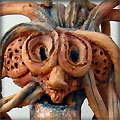
From sad portraits of Jews to intricate mosaics, Ilana Shafir has created many works of art. I had the pleasure of attending a Highland Park Arts Commission lecture Thursday night (thanks, Jill, for getting me out of the house) where Ilana spoke to a full audience.
Ilana was born in Sarajevo, Yugoslavia. She always wanted to study art formally, but as a teenager there was no opportunity. Then the Nazis invaded. Her family managed to escape to a little village called Kula, where she drew portraits of the villagers. When asked how she managed to get art supplies during the war, she replied: “It was a miracle.” After the war, she studied at the Art Academy of Zagreb. In 1949 she made Aliyah (moved to Israel). She settled in Ashkelon, where she still lives today, with a garden full of her mosaics and her whimsical ceramic creatures.
In order to find models for her portraits in her early days in Israel, she went to the local “ma’abara” (transit camp) and created sketches, paintings and prints of the exotic (to her European eyes) residents from Yemen, North Africa, and other areas of the world where Jews had left to come to Israel. I was disappointed that these lovely portraits as well as earlier ones from her European days, which she showed us in her slide show, are not on her website.
At some point someone said to her: “Who is going to hang portraits of sad Jews in their museum?” Around the same time she developed an allergy to turpentine. At first she wore gloves, but this was not enough. She told us a funny aside, that on Purim, when the kids dressed up as artists in Ashkelon, they wore gloves!
Her art style switched to fantastic ink and watercolor paintings, ceramic creatures, and finally, the medium she loves the most, mosaic. She told us it takes 6-7 months for her to complete a mosaic. Talk about stamina and drive.
If you are in Ashkelon, her mosaics are on display in various public places, including a syngagogue, where her mosaic of Jerusalem has the names of family members who perished in the Holocaust and a “Z”, standing for the star Jews had to wear in Sarajevo during the war. Other Jewish themes are the Burning Bush (shown under her photo on this post) and the Tree of Life (with one tree on top of another, each generation has its roots in the former generation, she explained).
The presentation was an introduction by her daughter, a talk by Ilana with slide show, and a short movie by her son, Giora. Learn more: http://www.shafirart.com/
Exhibit in Tsfat: Holocaust Yellow Badge in Art
(click on the Picasa link to see a slide show of the art)
I found this link on the latest Haveil Havalim # 164 – no names edition.

My daughter and I went for a walk on a lovely spring day this week. This is what we found:

Can anyone identify this tree?
It has to be a fruit tree, because on the tree we found this:

This is the bracha for a fruit tree. So my daughter and I said the bracha (blessing):
Transliteration: Boruch A-toh Ado-noi E-lo-hei-nu Me-lech Ho-olom She-lo Chi-seir Be-o-lo-mo Ke-lum U-va-rah Vo Be-ri-yos To-vos Ve-i-lo-nos To-vos Le-ha-nos ba-hem Be-nei A-dam.
Translation: Blessed are You, L-rd our G-d, King of the universe, Who has made nothing lacking in His world and created in it goodly creatures and goodly trees to give mankind pleasure. (This transliteration and translation is the Chabad version.)
and we went on our merry way.
If you are in Highland Park/Edison area, this tree is located on North 8th in Edison, near the Shabbos park.
 Feeling like a cold is coming on? Throat a little scratchy? Got a bit of post-nasal drip? Two staples to stock in your kitchen are garlic and ginger. I’ve cooked up the following concoction for mild ear-nose-throat ailments:
– Peel one garlic clove.
– Cut off one piece of ginger from fresh ginger root.
Slice off the skin of the root.
– Optional: a leaf of dark greens, such as collards or kale
– Optional: a dash of hot pepper sauce or a bit of a hot pepper
– Optional: fresh lemon (thanks for the reminder, Robin)
Place all ingredients in a mug. Boil some water, and pour it into the mug. Let it steep for about two minutes. Sip, and enjoy.
For my kids, who refuse the garlic, I put in a slice of ginger and a large spoonful of honey.
I am going to restate the obvious: make sure to get enough sleep. And may I add that if the cough or sore throat persists, please see your doctor.
In another post, I’ll write up my garlic spread recipe. Coming soon.
Another tip: try giving up sugar and dairy products for the duration of your cold; that may help the healing process along.
This post is dedicated to a friend that I hope is feeling better than when she asked me for a home remedy.

It is relaxing to start one’s day with a garden photo. In front are grape hyacinth, a bulb that one plants in the fall. Directly behind are dianthus plants, perennials that will soon bloom. Toward the back is a promising beginning of a black-eyed susan (Rudbeckia), a perennial native to New Jersey that may show its yellow flowers in August. The background is creeping phlox.
Who ate my tulips? Was it you? Or you?
Here are my tulips one week ago:

And here are the unhappy remnants today:

Most probably it was a deer. The deer live a few blocks away. Families that live close to RPRY on the Edison/Highland Park border report having a difficult time growing tulips. The deer gobble them up. In the past few years, gardeners in my neighborhood have also had to contend with the deer liking the taste of tulips. My neighbor down the block already knows of two ground hogs, but they nibble the ground plants. Like broccoli and canteloupe. Almost impossible to grow those here unless you grow them in a cage.

