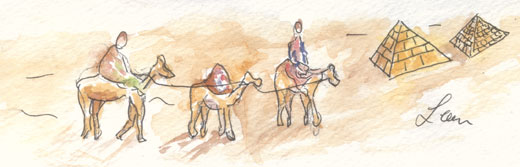
And there passed by Midianites, merchantmen; and they drew and lifted up Joseph out of the pit, and sold Joseph to the Ishmaelites for twenty shekels of silver. And they brought Joseph into Egypt.
The straightforward answer, as Rashi sees it, is that the brothers took Joseph out of the pit and sold him to the Ishmaelites and the Ishmaelites to the Midianites and the Midianites to the Egyptians.
I learned from my son, however, (it’s so wonderful when you can learn from your kids) that Rashbam (who is the grandson of Rashi; can you imagine challenging your own scholarly grandfather?) sees this differently. He suggests that the “they” who do the selling are the Midianites: “The brothers sat down to a meal at some distance from the pit, out of qualms of conscience and waited for the Ishmaelites they had seen. But before the latter arrived, others, Midianite traders passed, saw Joseph in the pit and drew him out and sold him to the Ishmaelites, presumably without the knowledge of the brothers.”
This helps explains Genesis 39:1, where Potiphar buys Joseph from the Ishmaelites. Other commentators complain that Rashi does not adequately explain this pasuk (how do the Midianites fit in? Who sold him to Egypt, Midianites or Ishmaelites?). But if the Midianites take Joseph without the brothers knowing and sells him to the Ishmaelites, then this pasuk makes sense.
Much more on this topic in Nehama Leibowitz’s New Studies in Breishit.
A much simpler question is why does the text in beginning of Miketz say “brothers of Joseph”? Rashi’s explanation is that they went down to Egypt to look for him, that he was very much on their minds (daughter of Mrs. S. said it was out of love for their brother). But if one follows Rashbam’s explanation, that the Midianites sold him and the brothers thought him dead, why does it say “brothers of Joseph”? (I don’t know).
• • •
While we are discussing Joseph, I just want to remark on what Rabbi Levi Meier, z”l, calls “Joseph’s astonishing ability to forgive his brothers.” In his book Ancient Secrets: Using the Stories of the Bible to Improve Our Everyday Lives, Rabbi Meier talks about Fate vs. Destiny: you can have reasons to hold a grudge, you can have a terrible start in life, and you can either sulk and not move forward or you can use it as a way to learn and grow:
Joseph’s forgiving is hard to achieve, especially when you have been terribly wronged by another person. In the case of Joseph, his life could have been ruined by the actions of his brothers. However, it was not, because he did not allow that to happen… Nursing your hurt feelings, your anger, and your bitterness will not bring you to happiness. It will only make you a slave to your fate, and you may never come to know that you could have freed yourself—that you could have been the master of your destiny.
I’ve been photographing the sneakers hanging from lampposts on my block, because I like looking at the same subject in different light.
It snowed last Friday, and the sky looked whitish gray.
These are actually two different lampposts, but both have sneakers hanging from them. I previously photographed the sneakers when the foliage was at its peak.
One may give a variety of answers, but a common answer is how Joseph dealt with Egyptian culture. In order to understand this better, we need to look at both the Hanukkah story and the Joseph in Egypt story.
What was the battle of Hanukkah about? There was a lot of pressure in Israel in the days of the Maccabees to conform and become like the Hellenists, to adopt Greek culture and shed Jewish traditions. Those that resisted, like Hannah and her martyred seven sons, became the precursors to today’s Jews.
Joseph, too, needed to live in a foreign culture. His was the world of ancient Egypt. He resisted the morals of that society; for example, he managed to get away from Potiphar’s wife. He never forgot his roots and was eager to reconnect with his family. At the same time, he worked on behalf of Egypt and was able to provide food at a time of famine.
Joseph can be viewed as a model of how one can integrate into a society, even in a leadership role, but not lose one’s heritage and traditions. In contrast, the Hellenized Jews of the days of the Maccabbees discarded far too much of their culture and are lost to history.
Mrs. S. gave the following: One answer is based on Ovadiah 1:18 (which is part of the haftarah for Parshat Vayishlach):
“And the house of Yaakov will be fire and the house of Yosef a flame, and the house of Esav for straw, and they shall ignite them and consume them; and there will be no remnant to the house of Esav, for Hashem has spoken.” She then clarified that comparing Yosef to a flame reminds us of Chanukah. And “giborim b’yad chalashim v’rabim b’yad me’atim” (“the strong in the hands of the weak, and the many in the hands of the few”) — Rashi is suggesting in the first pasuk of Vayeshev – based on the pasuk in Ovadiah – that one Yosef is more than sufficient to overcome all of Esav’s “chiefs”.
• • •
I had two more questions on Sunday:
1) Who sold Joseph? Was it the brothers or was it…? Here’s the pasuk in Vayeshev (Genesis 37:28)-
וַיַּעַבְרוּ אֲנָשִׁים מִדְיָנִים סֹחֲרִים, וַיִּמְשְׁכוּ וַיַּעֲלוּ אֶת-יוֹסֵף מִן-הַבּוֹר, וַיִּמְכְּרוּ אֶת-יוֹסֵף לַיִּשְׁמְעֵאלִים, בְּעֶשְׂרִים כָּסֶף; וַיָּבִיאוּ אֶת-יוֹסֵף, מִצְרָיְמָה.
And there passed by Midianites, merchantmen; and they drew and lifted up Joseph out of the pit, and sold Joseph to the Ishmaelites for twenty shekels of silver. And they brought Joseph into Egypt.
The text is not clear. To whom does “they” refer?
2) Why does it say the “brothers of Joseph” instead of “sons of Jacob”? Genesis 42:3 – וַיֵּרְדוּ אֲחֵי-יוֹסֵף
Any ideas? I’ll answer in a separate post. Stay tuned.
It’s that time of year when we light candles, play dreidel and eat… greasy food! Because of a greasy story two thousand years ago where a little jar of greasy oil lasted in the Temple for 8 days when it was only supposed to last for one. Since not much of the food in this post is greasy, I decided to call this the Greasy Story Edition, and not concentrate too much on greasy food (can one be yotzeh–fulfill one’s obligation–to eat food with oil by eating a salad with olive oil?). B’tayavon (bon appetit in Hebrew).
Another traditional food for Chanukah is sufganiyot, jelly doughnuts. No one posted a recipePhyllis posted a baked version, and I can tell you quickly my version: you make a sugary yeast dough, fry little balls of it in massive amounts of hot oil, dip the fried balls in yet more sugar, and inject with jelly. A delicious and fattening food.
Speaking of halacha, there are only supposed to be eight lights on a chanukiah, and then one extra for the shamash, the “helper” candle. Does anyone know why more show up in my photo? (Hint: the answer has nothing to do with halacha).
Sarah aka Proud Mommy's dreidel cookies
If you would like to participate in a future Kosher Cooking Carnival, please submit your post.
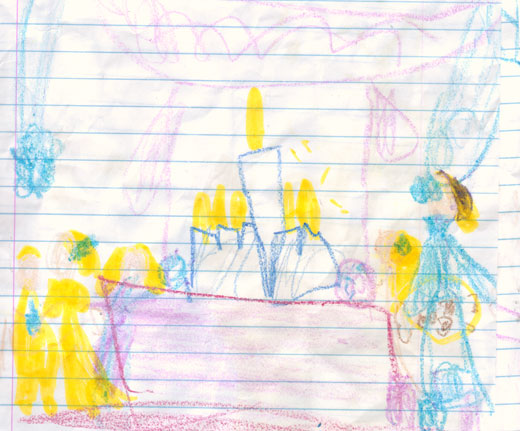
My daughter gave me a book of her drawings as a Chanukah present. I am supposed to write in the story myself.
Can you help me? Is this a queen or a princess? Who are those folks in yellow? Is that a cake in the middle? A castle? A cake of a castle? Oh, maybe it’s a chanukiah (a menorah)! And maybe some of you are better than me at understanding kids’ drawings.
Thanks and enjoy whatever holidays you are celebrating this week.
A view from Mitzpeh Netofa, Galil, Israel taken in June 2008
If you are a religious Jewish girl finishing high school and ready to spend a year in Israel, there is now a great option available to you. I got an email from my cousin who lives in Mitzpe Netofa about a new program called Midreshet Netofa.
Just so the rest of us can at least talk about our envy, here are some highlights of this program:
Learn by going on hikes and touring.
Explore creativity in art: light and form, perspective and composition, technique, elements of drawing, photography.
Meet with olive growers, wine makers and farmers as you learn about mitzvot associated with the land.
Learn about Kashrut in the classroom, in the kitchen, and out in the field.
Visit art museums, cultural centers, and performing art complexes.
Connect texts to Mitzvot between man and his fellow man.
Create your own family genealogy in the art studio.
Develop individual expression through dance, movement and music.
Study texts (such as Judges or the Book of Esther) with a focus on women.
Participate in events throughout the country for Yom HaShoah, Yom HaZikaron, Yom HaAtzma’ut, and Yom Yerushalayim.
Why do we read the story of Joseph at Hanukah time?
There are multiple answers to that questions. Feel free to give your own in the comments. Creativity is welcome.
I hope to post about the upcoming parsha on Thursday See the post on Joseph and Hellenization. On Wednesday, the Kosher Cooking Carnival will show up on this blog. You have until Tuesday to submit a food post. Thank you so much to the many folks who have already written about food! (I know food is a hard topic, one that none of us can relate to… ;-).
Back to the parsha, who sold Joseph? Was it the brothers or was it…?
And in the upcoming parsha, why does it say the “brothers of Joseph” instead of “sons of Jacob”?
Alternate spellings of Hanukkah: Chanukah, Chanukkah, Chanuka, Hanuka, Hanukah … only one in Hebrew: חנוכה
Hawthorn trees with beautiful crimson berries are all over Highland Park. This particular beauty is on Lawrence. Click on any of these to enlarge.
I couldn’t resist another post of hawthorn berry photos (see previous hawthorn berry tree).
This is as about as close as I can get to those berries without producing a blurry image (anyone want to buy me a new camera? The ones in the $3,000 range would do fine).
Same photo as above, cropped closer so it looks larger (thanks, Robin, for the idea).
This shot shows the thorns well.
It snowed two days ago, so I went around the corner to my local hawthorn tree and photographed these. Nice contrast to the bluer sky above.
I’m working on a post of Donaldson Park for My World, and I thought I’d throw in a sky above the park.
Tamar marries Er, the son of Judah, son of Yaakov and Leah. Er dies. She marries the next brother Onan, as the widow of a brother with no children should marry the younger brother. He dies. She is then supposed to marry Shelah, the younger brother. Judah is reluctant to give her Shelah. She is told to act like a widow. Tamar dresses like a prostitute and seduces Judah. In the process, she asks for his staff, signet and cord and takes them. Judah does not know she is Tamar. Tamar gets pregnant. She is ordered to be burnt to death. She brings out the staff, signet and cord and says, whose are these. Judah responds: "She is more righteous than I, for I didn't give her to Shelah." And then Tamar gives birth to twins, Zerah and Perez. Zerah sticks his hand out first, gets a red string put on it. But Perez comes out first completely. Perez is the ancestor of King David.
So my question on my previous post on Tamar was: Why does Tamar merit to become the ancestress of King David?
Rashi says it was because of modesty. Judah did not recognize her because she covered herself up while in his house. Does this mean a physical modesty? Or maybe she just kept to herself? Or perhaps it’s the way she presented his staff, signet and cord: she could have accused him outright, but she set it up so he could either reveal himself, as he did, or he could deny it, which he chose not to do.
We can understand this story as a growth of Judah’s character; it is juxtaposed to the sale of his brother Joseph for a reason. Judah did not behave well in the sale of Joseph (one could add he did not behave well in withholding Shelah from Tamar as well). At the end of this story, however, he does the right thing by Tamar in admitting that it was his staff, signet and cord and thus he was the one who had impregnated her. You can read more about Judah as penitential man in Rabbi Jonathan Sack’s post.
Getting back to Tamar, I do find it strange that someone who dresses as a prostitute is considered righteous and a role model. But I suppose she knew she needed to carry the ancestor of David, and she knew it should be from Judah.

 A much simpler question is why does the text in beginning of Miketz say “brothers of Joseph”? Rashi’s explanation is that they went down to Egypt to look for him, that he was very much on their minds (daughter of Mrs. S. said it was out of love for their brother). But if one follows Rashbam’s explanation, that the Midianites sold him and the brothers thought him dead, why does it say “brothers of Joseph”? (I don’t know).