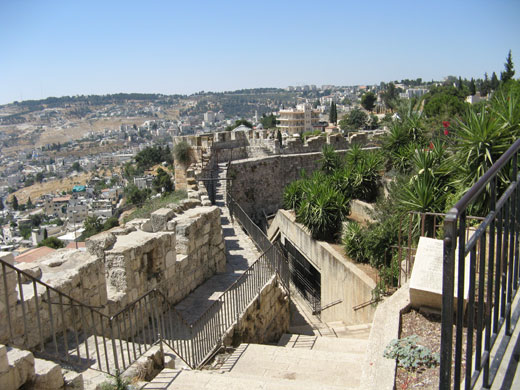
Wall of the Old City, Jerusalem, July 2008
Fifty years ago Jews could not walk here, along the walls of the Old City. There was a barbed wire fence preventing entrance. In 1967 all this changed, and thus tonight begins Yom Yerushalayim, Jerusalem Day. After June 1967 not only were Jews and others allowed into the Old City and to visit the Kotel, the City was once again in Jewish control, as it had not been for 2000 years. Jerusalem has been a holy city for the Jewish People since the time of King David.
From Wikipedia, here is what Moshe Dayan said on that day:
This morning, the Israel Defense Forces liberated Jerusalem. We have united Jerusalem, the divided capital of Israel. We have returned to the holiest of our holy places, never to part from it again. To our Arab neighbors we extend, also at this hour—and with added emphasis at this hour—our hand in peace. And to our Christian and Muslim fellow citizens, we solemnly promise full religious freedom and rights. We did not come to Jerusalem for the sake of other peoples’ holy places, and not to interfere with the adherents of other faiths, but in order to safeguard its entirety, and to live there together with others, in unity.
Posts on Jerusalem Day or about Jerusalem in the news:
Jack hosts this week’s Haveil Havalim, the weekly blog carnival of the Jewish Blogosphere. He compares Haveil Havalim to the famous scene from Night at the Opera, when Harpo, Chico, Groucho and too many others crowd into an ocean liner cabin.
And I updated my Pics of the Month page. The page features some of my favorite paintings, photos or Flash creations. Featured in this post is a watercolor I did in 2007. Any ideas why I chose it for this post?
My son (the middle son, the filmmaker) went on a field trip last week with his class to the Rutgers Agricultural Museum in New Brunswick. Here is an old-fashioned firetruck that he photographed. (I didn’t go on the trip; he took his own camera).
Part of the reason for the trip was the boys have been studying the 39 Melachot, the 39 acts of work that a Jew is not allowed to do on the Sabbath. All of these Melachot are agriculturally-based, so their teacher used the museum as a way to show them threshing, winnowing, grinding sheaves (I have no idea what those are; I took those words off Wikipedia). Each boy had been assigned one Melacha to study in detail.
My son’s Melacha was weaving. He had already presented to the class, and his teacher told me later that he gave my son weaving because it was a more difficult one, but he knew my son could handle it. He did an origami basket project with his class. Yes, I am proud of him!
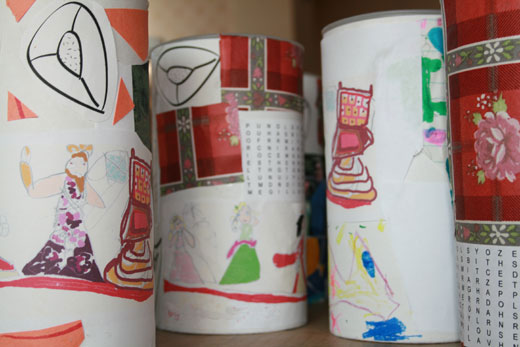
Our family decorates oatmeal containers with colorful pictures and scraps of wrapping paper. We modge podge (a kind of glue) the containers, fill them with treats and give them to our friends. This custom is called Mishloach Manot, and it is part of the celebration for the holiday of Purim. On the container at left you can see King Ahashverosh by his red throne.
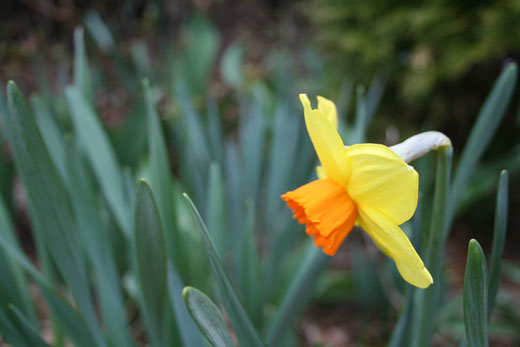
I love the idea that trees and flowers are blooming in Israel. Anyone who lives in the north can probably appreciate the envy I feel at this time of year. So I’ll start with Batya’s blooms:
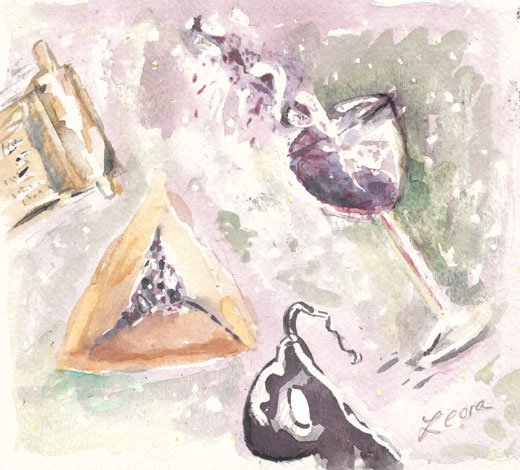
While G6 reminds us Purim is coming, Mottel shows us Chanukah past (and here’s my Purim watercolor, too):
Leah presents three from the Chossid’s blog:
Some lovely, some dusty shots on Israeli blogs (Rahel, Yisrael M., CosmicX):
New York on view (by Wolf, Jacob, JoeFlix and Mendy):
Mottel showed South America (Pisaq, Machu Picchu), Ilana-Davita a Hong Kong shul:
Purim is Coming, watercolor by Leora Wenger, 2009The Jewish month of Adar starts this week. When Adar comes, our sages tell us, we increase in happiness. Just as in the Purim story that we will read in the middle of Adar our fortunes turned from bad to good, so we should turn around our sadness into happiness.
Two thoughts on how this happiness needs to be tempered:
1) This year marks the first anniversary of the terrible murder of 8 teenage students from Merkaz HaRav in Jerusalem.
2) It is a custom to drink alcohol on Purim. However, one must always take care of one’s health and the health of others. Therefore, if you or family members do not know how to drink responsibly, don’t. We don’t need the happy day of Purim to turn to tragedy.
So I said to my husband: is this a bit like “People who live in glass houses should not throw stones”? And my husband responded, but even if you weren’t a stranger in Egypt, you shouldn’t abuse a stranger.
But I don’t think it’s a good idea for people who live in brick houses to throw stones, do you?
Tree sculpture at the Tower of David Museum in Jerusalem
Esser Agaroth hosted the #203 edition of Haveil Havalim, the weekly blog carnival of the Jewish blogosphere. In addition to Tu B’Shvat, the holiday of the trees, this coming week means elections in Israel. Israel has many different parties; governments are formed by coalitions (want to learn more about the Israeli Political System? Take Prof. Yaacov Yadgar’s free, online course on the Israeli Political System). You can learn more about how bloggers vote by reading this week’s HH edition. I found Cosmic X’s post: Are Most Israeli Bloggers Leftists? interesting: the leftists are writing in Hebrew, the right wingers in English?
Please calm me down, as I am hosting next week’s Haveil Havalim. This won’t be too hard, will it, Jack? Will I be clever, witty enough for this prestigious task? Stay tuned.