WARNING: NOT BASED ON YEARS OF SCHOLARLY RESEARCH, just a quick drawing in Photoshop
Thirty three years ago I stood in my the hallway of the home I grew up in (it was a large, grand hall: wasted space, took up heat, but beautiful) and gave a speech. My father wrote the speech. I really don’t remember what the point of the speech was, but I do remember the first pasuk (sentence) of the speech, which is the first line of the upcoming parsha:
And it came to pass, when Pharaoh had let the people go, that God led them not by the way of the land of the Philistines, although that was near; for God said: 'Lest peradventure the people repent when they see war, and they return to Egypt.'
So I remember bits and pieces of it. There was a dog, and a son, and a father. The drawing on the map probably was not part of the speech, but might have been if I had written the speech. So I would have an excuse to draw charts and pictures. The red line represents the route B’nei Yisrael (the Israelites, Children of Israel) most probably did take, so they would have a long time between slavery and being a nation in a land. The blue line is the more direct route, the one they didn’t take, which seems to go close to what is now Gaza or what was then the nation of the Philistines, a war-like people. In any case, they did meet Amalek at the end of the parsha, so they got involved in a battle, anyway.
So what was the story about the dog, the son, the father? I had to look it up. It’s from a Rashi towards the end of the parsha. It seems the father and son were going on a journey, and the son wanted to be held. So the father picked him up. Then the son wanted this. The father gave it to him. The son wanted that. Again, the father generously gave to his son. Along came another man, and the son asked, Do you know where my father is? The father got angry and put the son down. Along came a dog (Amalek) and bit him.
Now, if I could choose a topic now for my bat-mitzvah, I would have chosen Shirat HaYam, the song of the sea. Maybe next year I will study the beautiful poetry in this week’s parsha. Last year I wrote about Devorah. One thing I will have to say: even if I didn’t write the words to my bat-mitzvah speech, it was this speech that was my introduction to writing and giving divrei Torah, words of Torah. I enjoy it! So, thanks Dad (I actually used to call him Daddy, but now we call him Saba, grandfather) for helping me along this path.
The photo on the left shows me conducting some kind of game at my bat-mitzvah. The photo on the right is from my brother’s bar-mitzvah one year earlier; I am sitting in the same location that I stood one year later to give my bat-mitzvah speech.
On the fifteen day of Shevat, there is a Jewish holiday called Tu B’Shevat. This year Tu B’Shevat falls on Monday, February 9th.
The celebration often involves eating special fruits, especially figs, dates, almonds and carob. As a little girl growing up in New England, I often thought it strange that we celebrated a day for trees in what felt like the middle of a snowy winter to me. But the day is about the agricultural cycle in Israel. It started because the rabbis needed a day to begin counting certain laws such as Orlah, the three years one must wait for planting a fruit tree before enjoying the harvest.
The photo at left, which you can click to enlarge, shows some trees in Jerusalem in front of the Montefiore Windmill. The blue sign says “Heinrich Heine” (Road). Heine was a German poet. I chose the photo for this post because of the variety of trees in the photo. Also, because the photo reminds me of the story I told about my eighty-year-old friend identifying trees in Jerusalem.
In celebration of the upcoming holiday, I decided to post a few of my favorite tree photos.
Ilana-Davita hosted a wonderful JPIX, the blog carnival of photos (and drawings, one in this carnival) by Jewish bloggers. Thank you for including my bench of roses detail and my cup. If you visit the carnival, you can find the link that will lead you to the post that will tell you in which restaurant I took that photo.
This month shall be unto you the beginning of months; it shall be the first month of the year to you. (Exodus 12:2)
I learned this week that the Chinese calendar is like the Jewish calendar, as it follows the moon, but it has a correction, a leap year of some sort so the holidays stay in the right seasons. So some bloggers this week were wishing me Happy Chinese New Year while others were wishing me a good month (it was the beginning of the Hebrew month of Shevat). It occurred on the same day because of the moon.
In this week’s parsha, the moon first becomes a symbol of hope and renewal for the Jewish people. There are many Jewish laws (halachot) regarding the sighting of a new moon. In the days of old, witnesses who saw the new moon would set fires on a string of hilltops to let neighboring and far communities know of the new month. Now we follow a calendar.
Note that God’s symbols, as presented in the Bible, are generally elements of nature: a tree, a rainbow, a rock. The Bible imbues these natural elements with meaning, and each symbol is intended to give us strength to face the challenges that arise.
So when the pharaoh’s rage is unleashed as he is threatened with the last of the ten plagues—the death of all firstborn Egyptian males—the Israelites are told to look to the new moon.
It does seem strange, that amidst these plagues, the concept of Rosh Chodesh, the new month, is introduced.
Rabbi Meier continues:
The new moon silently speaks to them of renewal, of a new beginning. The moon returns each night to light the darkness, changing its shape, waxing and waning, only to rise afresh after a cycle of twenty-eight days. It speaks to them of the cyclical nature of life.
Just as the Israelites are getting ready to leave Egypt, they are given not only a symbol of hope but also a reminder that life is like the moon. It, too, moves in cycles. In the worst of times, it is important to remember that there will always be renewal.
The cycles of waxing and waning, of trust and mistrust, of intimacy and distance, of joy and despair, are all normal. A great deal of unhappiness in this world comes from our refusing to acknowledge this simple fact. When things are going well, we want to hold on to those feelings of happiness and bliss. But happiness gives way to sadness, as it surely must. And we suffer needlessly, agonizing over the realization that happiness, once achieved, cannot last forever. In the midst of our disappointment, we forget the moon will rise again, bringing joy once more.
The great figures of the Bible understood that we need “down” cycles in order to have “up” cycles. Thus, even in the worst of times, they were never immobilized by despair. They used the dark moments to change, to grow, and to move forward.
Why mention Elisheva’s brother? (and who is Elisheva…)
Why the Nile? Why was the first plague on the Nile?
1) Elisheva, who married Aaron the brother of Moses, was the brother of Nachshon Ben Aminadav. Why mention her brother? Because when you get married, you should check out your future wife’s brother (according to Rashi). So my husband said to my sons, he checked out my brother before marrying me, that’s how he knew he would have sons who love computer games. To which my middle son said, “And chess, too!”
2) Nile:
Raizy came up with a good answer:
Why was the first plague on the Nile? It was mida k’neged mida (direct retribution). The Egyptians threw newborn Jewish boys into the Nile, so now the Nile is being used to punish them in return.
Her second answer is similar to the one Rashi gives in 7:17 — the Egyptians worshiped the Nile, as the Egyptians were dependent on the rise of the Nile to water the land, as rain did not fall in Egypt. So God struck their deity.
Raizy adds: “So turning the holy water of the Nile into blood demonstrated that the God of Israel is more powerful than the gods and sacred places of Egypt. It was meant to instill fear and awe.”
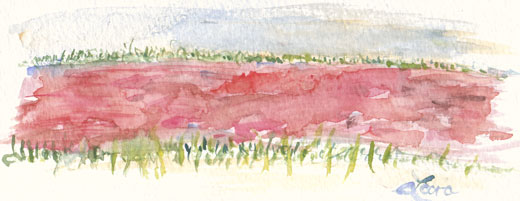
Another answer is found in the Rashi of 8:17 with an aggadic story: God came against the Egyptians following the tactics of the wars of kings, in the order of measures a kingdom takes to when it lays siege to a city. At first it ruins the city’s springs of water (bloody Nile, as shown in the watercolor above). Afterwards the besieging forces sound and blow shofars at the inhabitants of the besieged city to scare them and confuse them. By the same token, the frogs croak and make noise, etc., as it says in Midrash Rabbi Tanchuma. The shofar blasts are followed by hails of arrows, comparable to lice. Then foreign mercenaries are sent in, like the mixture of wild beasts. The pestilence corresponds to a mass seizure of captives. This is followed by an attempt to burn the enemy out — the boils. The hail is like a bombardment of catapult stones. Next comes an attack by a large army (locusts). If the enemy does not surrender, they are held in prison (darkness). If the enemy is still not vanquished, its leaders are executed — the killing of the firstborn.
• • •
Here’s one more quicky that I learned from my son: how can you remember how many plagues are in Parshat Vaera and how many are in Bo? (hint: if you know gematria, that helps. Gematria is adding Hebrew letters as if they are numbers. So aleph is one, beit is two, and so on).
A reminder: just as we empty drops of wine on Passover because we are not allowed to rejoice over the death of the Egyptians in the sea, we are not allowed to enjoy the suffering of our enemies, even if they have created pain for us.
Ratatouille, a traditional French Provençal stewed vegetable dish
Ilana-Davita has hosted her first Kosher Cooking Carnival, and she named it the “Green Edition” because it is mostly meatless recipes and because it is almost Tu B’Shevat, the holiday of the trees. I thank her for including my matzo ball recipe and my ratatouille.
Looks like Tu B’Shevat will occur this year on Monday, February 9th. Maybe I’ll do a little collage of tree photos in honor of the day. It was always strange to me, growing up in snowy cold New England, that one celebrating the planting of trees in February. But Israel has a much different schedule than here, so I suppose February is a good time there to plant a tree!
Speaking of matzo balls, my middle son (he’s twelve) made the matzo balls on Friday. I dictated the recipe to him by heart, as I was rushing off to take a shower about an hour before Shabbat. When he asked “how much oil,” I yelled, “some.” The matzo balls came out absolutely delicious. When I asked him how he did it, he claimed he “worked the balls a lot.” Which is sort of the opposite of conventional wisdom on how to make a good matzo ball. He also made a “chocolate chip pie” using a muffin recipe cooked in a round pie tin. That got devoured, too. And I had enough time to make my cole slaw with red and green cabbages, brussel sprouts and garlic spread.
I was away with my family since Monday, but I did have time to read over the parsha questions I receive in email each week. Maybe you can guess some answers for these two:
Why the Nile? Why was the first plague on the Nile?
Why mention Elisheva’s brother? (and who is Elisheva…)
If you know any of the answers, feel free to comment. If you don’t, take a guess! I’ll post Rashi’s answers early next week.
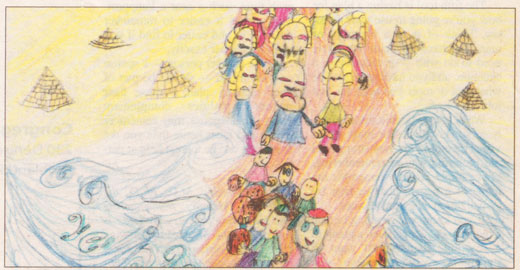
Leaving Egypt, drawing by my son, won Honorable Mention in 2006 Passover Art ContestThis week the parsha is no longer features the family stories of Abraham, Yitzchak, Yaakov and Yosef. The tone of the text changes, and the focus is on a group of people in slavery, leaving Egypt and nation-building.
Robert Alter writes in his Translation with Commentary: The Five Books of Moses:
As the long historical narrative of the Five Books of Moses moves from the patriarchs to the Hebrew nation in Egypt, it switches gears. The narrative conventions deployed, from type-scenes and thematic keywords to the treatment of dialogue, remain the same, but the angle from which events are seen and the handling of the characters are notably different. Genesis ended with death, and the distinctly Egyptian mummification, of Joseph. Exodus begins with a listing of the sons of Jacob who came down to Egypt, thus establishing a formal link with the concluding chapters of Genesis in which a more detailed list of the emigrants from Canaan is provided…Instead of the sharply etched individuals who constituted a family in all its explosive dynamics in Genesis, we now have teeming multitudes of Israelites whose spectacular prolificness introduces to the story the perspective of the whole wide world of creation announced at the beginning of Genesis: “And the sons of Israel were fruitful and swarmed and multiplied and grew very vast, and the land [הָאָרֶץ same word as in Genesis] was filled with them” (Exodus 1:7).
Nahum Sarna in Exploring Exodus explains the title:
It is called in English “Exodus,” a title derived originally from the Septuagint, the Greek translation made for the Jewish community of ancient Alexandria in Egypt. It is abbreviated from a fuller title “The Exodus of the Children of Israel from Egypt,” which in turn reflects a Hebrew title current among the communities of the Land of Israel. The most widely used Hebrew name is Sefer Sh’mot (“The Book: Names”), taken from the opening Hebrew words of the book, “These are the names of the sons of Israel.”
Here’s how Sarna connects Exodus to its predecessor Genesis:
The narratives in Genesis focus upon individuals and the fortunes of a single family; they center upon the divine promises of peoplehood and national territory that are vouchsafed to them. In the Book of Exodus, the process of fulfilling those promises is set in motion…God’s commissioning of Moses at the scene of the Burning Bush directs him: “Go and assemble the elders of Israel and say to them: the Lord, the God of your fathers, the God of Abraham, Isaac and Jacob, has appeared to me and said “I have taken note of you [Heb. paqod paqad’ti] and of what is being done to you in Egypt…'” This is a studied echo of Joseph’s dying words “God will surely take notice of you [Heb. paqod yiphqod] and bring you up from this land to the land which He promised on oath to Abraham, to Isaac, and to Jacob.”
In the previous parshiot, the ones of Breishit, we got to know the characters well. In Shmot, we still can learn from the people presented in the parsha, such as the daughter of Pharoah, but I feel more distance. Perhaps we can see the upcoming parshiot as a bridge from character portrayal to nation-building and the giving of the Torah in the middle of the Book of Shmot.
Do you find transitions hard? How do you see the change from the Book of Breishit (Genesis) to the Book of Shmot (Exodus)?
A beautiful song is in this week’s parsha of Vayechi. The scene is Yaacov on his deathbed, blessing his grandsons Ephraim and Menashe. Part of the blessing has become a pretty song that parents often sing to children at bedtime.
Translation in English:
“May the angel who redeemed me from all harm bless the youths, and may they be called by my name and the name of my fathers, Abraham and Isaac, and may they grow into a multitude in the midst of the land.”
Click on the little girl to see the same little girl with Play and Pause buttons. Click on Play to hear my daughter (and me) singing the song. Or click here for song. (I couldn’t get the Flash to embed directly in this post; one still needs a plugin for this.)
Rashi states that “the youths” refer to Ephraim and Menashe. But I like to think of the youths as any kids that are in the room at the time the song is being sung.
Hope you will find this relaxing and a calming way to get through the rest of the week!
Rafi hosts the “cut short by the war” edition of JPIX, the blog carnival of Jewish photo bloggers. I greatly appreciate his link to my post on the Dead Sea and Ein Gedi and the inclusion of my ibex photo (see that cute guy at right).
Speaking of blog carnivals, Ilana-Davita will be hosting the upcoming Kosher Cooking Carnival, so be sure to submit a food-related post to her. This past sentence will appear on my blog on Asarah B’Tevet, the 10th of Tevet, so I apologize in advance to anyone who reads these words while fasting.





 Last year:
 Rafi hosts the “cut short by the war” edition of