Excluding the first photo with the red and yellow trees and the hanging shoe, the five sunset shots were taken within minutes of each other. I decided to use the Word Press photo gallery to set up this post. Unfortunately, you have to click twice to get the larger image, and then you have to use the back button to get back to the main post. Maybe Word Press 2.7 will improve this tool?
For more Skywatch participants, please visit:


I took this photo last July at the Jaffa Gate outside the Old City of Jerusalem. I’ve wanted to post it, but I needed to rework the face in Photoshop so her face is no longer recognizable.
Why is she looking up, but holding the prayer book in her hand? Is it a book of Tehillim (Psalms)? What is distracting her?
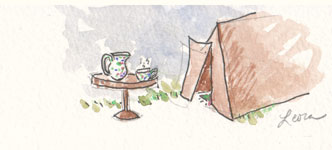 In this week’s parsha of Vaera we learn about hospitality, known in Hebrew as Hachnasat Orchim, welcoming guests. We have two examples of hospitality, one as Abraham welcomes three men (it does not say angels in Genesis 18:2) and another of Lot, who invites two angels to visit him.
How is Abraham’s hospitality different from that of Lot? For one, Abraham welcomed three men whom he saw as wanderers, not as angels, whereas Lot invited in angels. Rabbi Frand (from Rabbi Frand on the Parashah 2) differentiates the two greetings; Abraham welcomed men wandering through the wilderness, Lot was only welcoming because he saw angels. But at the same time, Lot had learned something from Uncle Abraham’s example.
Rabbi Frand writes:
Lot…saw angels. Lot was hospitable, but he wasn’t going to have just anyone at his house… Lot had learned enough from his uncle Avraham to invite the angels in, but he had not learned a most important lesson: you don’t handpick your guests. True hachnassas orchim is to make everyone feel welcome at your home, angel or human. And human, we might add, applies to all humans, even those that come from the less genteel segments of society.
Rashi brings another difference in their hospitality. Abraham requested that the travelers remove the dust from their feet first and then enter. Lot invited them to enter with dusty feet. Abraham saw his guests as worshipers of dust and did not want to bring their idol worship into his home. Lot, on the other hand, knew that the people of Sodom objected to Hachnasat Orchim so to protect the visitors suggested the guests remain with dust on their feet so it would appear as though they had just arrived.
I do like having guests over, though I can’t say I always feel up to it; some weeks I feel more inclined to entertain than others. But I do welcome my daughter’s complaint when we don’t have guests (“no guests this week?” she has been known to say). I like that she appreciates Hachnasat Orchim, welcoming guests into our home.
Finally, I struggle with Rabbi Frand’s idea of welcoming anyone into one’s home. Anyone else have their doubts or thoughts about this?

I have been making lentils in various forms this fall. The lentils in the bowl above were made overnight in my crockpot.
Lentil Soup with Curry
Ingredients:
- 1/2 lb. lentils
- 3 cups of water
- 1 garlic clove
- 1 slice of ginger root
- Salt, turmeric, cumin to taste
Put all the ingredients except the spices in the crockpot. Cook on low overnight. In the morning, add the salt, turmeric and cumin.
Lentil Salad with Lemon Juice
Ingredients:
- 1/2 lb. lentils
- 1 1/2 cups of water
- lemon juice, preferably from fresh lemons
- salt to taste
- optional: parsley
The key to making lentil salad as opposed to lentil soup is use less water. Cook the lentils with the water for about two hours (this is how long it takes in my crockpot). When the lentils are tender, add the lemon juice and salt. Garnish with parsley. Can be served hot or room temperature.
Lentil Soup with Tomatoes
Ingredients:
- 1/2 lb. lentils
- 3 cups of water
- 1 garlic clove
- 1 slice of ginger root
- Handful of baby carrots
- 2 sliced zucchini
- 1 can whole tomatoes
- Salt to taste
- Optional: jalapeno pepper, chopped
Cook the lentils, ginger, garlic and carrots in water until the lentils are tender (two hours in my crockpot). Add zucchini and salt (add jalapeno pepper, if using one). When zucchini are almost tender, add the canned tomatoes.


American flags were flying high today in honor of Veterans Day on Raritan Avenue, the main street (also known as Route 27) that runs through the center of Highland Park.

First, thank you to Babysitter for including the above image of stars in her post on Lech-Lecha.
ck at Jewlicious did a marvelous job of Haveil Havalim #190: Post Election Panic.
Hadassah Sabo premiered the Yiddishe Mama Blog Carnival.
Juggling Frogs posted the overdue Carnival of Overdue Thanks.
I would like to get back to a link Ilana-Davita posted last week on health. I’m taking one quote off the article from the doctor who beat cancer:
Along with fried foods and sugar, one of the book’s other targets is margarine, which he describes unequivocally as “a lot more dangerous than butter” for its role in cardio-vascular disease and obesity. He refers to the “Israeli paradox”, in which Israelis have among the lowest cholesterol levels in Western countries, “combined with one of the highest rates of cardiac infarction and obesity”. The cause, he explains, is the kashrut imperative to separate milk and meat, which has led to the use of margarines as a substitute for butter.
And thank you to those who reminded me that it is Armistice Day. We Americans call it Veterans Day. In any case, thank a veteran today.
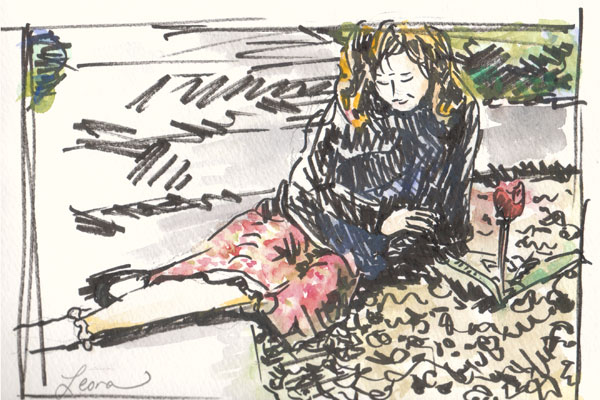
I did this with ink pens, and then for the color I applied watercolor paints. It is a study for a painting that I’ve started. It may take me months to finish. I’m in no rush.

My neighbor down the block had these pretty flowers growing in front of her house about a month ago. Neither she nor I know the names of the pink flowers. I suspect that the orange ones are probably a zinnia (thanks to readers who confirmed this). Anyone know about the little pink ones?
Today’s Flowers is hosted by Luiz Santilli Jr. Thank you, Luiz, for this lovely meme.


It’s been a beautiful autumn here in Central New Jersey. The color is everywhere; I think the weather has been cooler and damper than previous autumns, and the trees are loving it.

These top two photos were both taken on my block. The one with the window is directly across the street, and the other, with the reds to each side and yellow in center, is looking down the block.

These last two photos were taken outside my kids’ school, which is in Edison, New Jersey, just over the border from Highland Park.

How does it look where you live?
 More links to beautiful autumn photos on Carmi’s Thematic Photographic: Autumn post
A number of readers asked if I could explain how I arranged the images for the JPIX carnival.
Step one: Gather the images
When there was an image that I wanted to use for JPIX (many of the posts, even if submitted, had multiple photos), I right-clicked on the image and saved it to my hard drive. I tried to name the jpg (the common file format for a photo) by both something in the photo and something in blog’s name.
 For example, I named the photo at right lastrose_id.jpg, with the lastrose part being a reminder that post was named “Last Rose” and the id part as a reminder that it is Ilana-Davita’s photo.
After saving a bunch of photos in this way to my hard drive, I had quite a collection, but in some cases I still had to hunt when I got up to the part where I linked the photo online, because some blogs had lots and lots of photos in one post. So in those cases one also might want a reminder of the placement of the photo in the post (middle, 6th, or bottom might be examples to add to the name of the file).
Step Two: Sizing Those Images
So how big to make each of those images? At first I thought to make each one 150px high. After uploading about twenty at 150px high (this was a mistake, I should have just done three and tested those), I decided I preferred 115px high. You will see on the carnival that most are this height (to see the height of a photo, right-click and select Properties), but some were other heights.
In order to resize a photo, you open a photo editing software package and change the height size to 115px. The software should proportionally scale down the width for you.
Step Three, easy: Arranging the Photos
First, I’m going to tell you an easy way. Just upload each photo to your post, line up three on a line, and link each photo to the original post. It might look nice to put a space between each photo. I often do this in code by typing: Here’s an example:
Step Three, complicated: Arranging the Photos with Blog Links
Since I wanted the blog to have the blog links directly under each photo, I used table tags. I will discuss table tags in another post, next week.
To be continued…
