Today’s Flowers: Chrysanthemum

I took a lot of photos of the chrysanthemum in front of my house, as it’s in full bloom.
See other mum photos:


Today’s Flowers is hosted by Luiz Santilli Jr. Thank you, Luiz, for this fun photography meme.


I took a lot of photos of the chrysanthemum in front of my house, as it’s in full bloom.
See other mum photos:
Today’s Flowers is hosted by Luiz Santilli Jr. Thank you, Luiz, for this fun photography meme.

The best of the Jewish and Israeli Blogosphere:
Baila hosts Haveil Havalim #187.
And Eric hosted Haveil Havalim #186 (my apologies to Eric for getting the link up this late; it’s been a busy week).

How does one purposely produce a blurry picture? At night, with little lighting, it is easy, because the camera wants to open the shutter for longer, allowing in more light. No one stays perfectly still at a party (this was taken at a Simchat Beit HaShoeva at my kids’ school), so I got lots of blurry pics.

In the middle of the day, however, it’s a bit harder. I set my camera to shutter speed priority, selected a slow setting so the shutter would stay open longer, and got the above photo.
Yesterday I took a photo of a bee on a mum that I love; however, that one blurred only the background. So this time I challenged myself to blur the main subject as well. I achieved the bee on mum with background blurred by setting the aperture as priority, sort of opposite of the technique the above photos.
 For more blurry photos, see Carmi’s post on Thematic Photography 20 – Blur.
 |
 |
 |
 |
 |
 |
 |
 |
 |
 |
 |
 |
I took these photos of the same area of sky, looking southwest from my house, in late September and early October. If you click on the little thumbnails, you will be taken to my Flickr account. It was my first experiment with using Flickr. It helped me organize this post.
This one is my favorite:
For more Skywatch participants, please visit:


I worked hard to get the background behind the bee to blur. The aperture value was 2.8, the lowest on my camera, which seems to be what causes the background to blur.

I prefer zinnias before they are at full bloom, like in this opening bud. I planted these zinnias from seed (I started them in little containers outside my kitchen door in late spring). I got the seeds for free at the Highland Park Street Fair.

Here they are in my garden, along with orange marigolds and white mums.
Today’s Flowers is hosted by Luiz Santilli Jr. Thank you, Luiz, for featuring flower followers who share photos in a fun fashion.

I am fortunate that I can work at home. Sometimes, especially now that the weather is getting chillier, I set up some food cooking in my crockpot first thing in the morning, and the house smells yummy at lunchtime (and I have something new to eat). Last week I was hoping to make lentil soup one day, but I reached into my cabinet and found no lentils. I had just bought some cut up butternut squash the day before. If you have ever cut a butternut squash, you will know what a time and energy saver pre-cut squash can be. The squash even had an O-U on it, meaning it was cut with a kosher knife. I created this recipe:
Ingredients:
Cook the butternut squash and ginger in the crockpot with some water to cover (or even a little less water) for about two hours or until squash starts to get soft. Add chopped tomatoes and greens. It’s ready when the greens are slightly cooked (not long!). If there’s excess water (I had enough to fill one mug), drink that in a cup: it’s a delicious broth!
I did buy the lentils later in the day, and so I made a lentil soup in my crockpot the next day. I’ll post a lentil soup recipe another time.
 Batya is hosting the Kosher Cooking Carnival this month, and she is awaiting your food posts. It doesn’t need to be a recipe. Submit a KCC article by October 27 with the KCC blogcarnival.com page. Batya describes KCC:
KCC accepts posts about all aspects of kosher cooking, including Halacha, tradition, jokes, anecdotes, restaurant and cookbook reviews.
And I will be hosting the next JPIX, the carnival of images presented by Jewish bloggers. Little Frumhouse on the Prairie is the “manager” of this blog carnival. Submit a JPIX article by October 31 with the JPIX blogcarnival.com page. Carnival description:
JPix is a carnival for Jews and their pictures, it doesn’t necessarily have to be that ‘joyous expression of art’ which photography can capture, it doesn’t have to be just about photos of Eretz Israel, though they are most welcome. It’s not even about communicating some deep spiritual meaning in a long photo essay, although that’s all right, too. It’s about two things: You’re Jewish and you have photos you want to share, whether they be family, historical, artful, funny, quirky. It’s about sharing.
And anybody in the whole wide world with internet access can enjoy the JPIX carnival.
So, if you are preparing for the upcoming holiday of Sukkot, write up a recipe. Write up your menu. Photograph your Sukkah. Photograph your lulav and etrog. Photograph your kid’s (or some other person’s kid’s) Simchat Torah flag. Draw a picture with crayons of a sukkah, and post that. Describe the vast quantities of food you have eaten during these holidays. Post a food joke. Thank you!
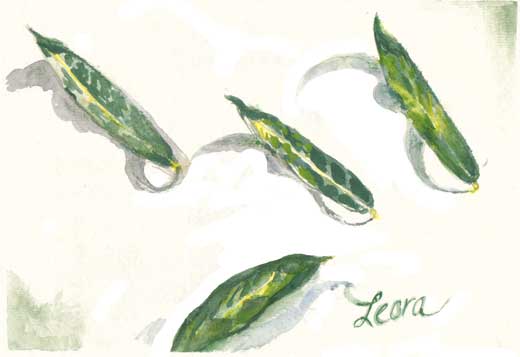
Wednesday morning I did this little watercolor of an arava leaf (you might recognize it as a willow leaf, its name in English). It is one of the many natural symbols in the upcoming holiday of Sukkot, which starts on Monday night, Oct. 13. I actually was only looking at one leaf, which I painted a few times on the same piece of watercolor paper. My son planted a little willow branch in the backyard this year, and I was afraid if I took off more than one leaf off the little “tree”, there wouldn’t be much tree left. My other son agreed that I should put some compost around the edges of the little plant. It certainly has been getting enough water, as we’ve had rain on and off lately. Maybe I’ll photograph our little willow for another post.

My daughter and I worked together on this drawing last night. She nicknamed it “the fun house”. So, what do you see? (click to enlarge)