Today’s Flower: Chrysanthemum

My chrysanthemum (or “mum” for short) showed its first bloom last week.
Today’s Flowers is hosted by Luiz Santilli Jr. Thank you, Luiz, for this fun photography meme.


My chrysanthemum (or “mum” for short) showed its first bloom last week.
Today’s Flowers is hosted by Luiz Santilli Jr. Thank you, Luiz, for this fun photography meme.
Setting up an art show is not as easy as it looks.
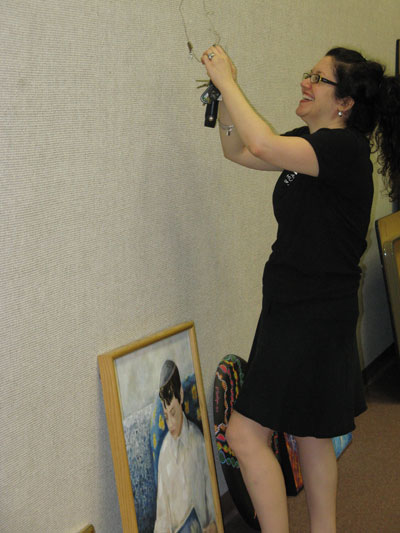
Or maybe you are thinking, who says I ever thought this was easy?
My daughter and I helped Jill with the set up on Wednesday afternoon.
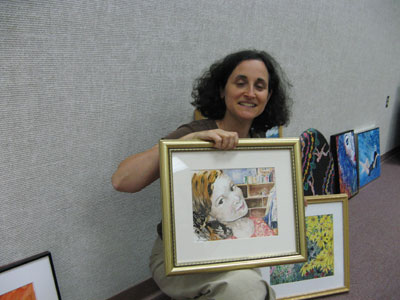

Jill was at the library setting up on Thursday night and for several hours on Friday. I’ve gotten emails on the progress; and I will gladly be supplying the lemonade in memory of Kiersten.
The art show is from 2 – 5 pm at the Highland Park Public Library.
Hip, hip, hooray for Jill!
First, an aside: we went to a bar-mitzvah yesterday of a boy that I’ve known since he was a baby. He gave a wonderful speech, and as part of the speech he said (from memory, not his exact words): “Don’t people have a natural ability to detect what is the right thing to do? In my experience, they don’t, and so we need the Torah to teach us.” This was in reference to finding a dead body in a field; what does one do? How to be a responsible person does not come naturally.
Deuteronomy 16:20—
“Justice, Justice, you shall pursue”
Whenever the Torah repeats, there is a reason. Why the doubling of “Justice, Justice, you shall pursue”?
(One could also translate ‘tzedek’ as righteousness instead of justice).
The most obvious answer is “emphasis”. This is one of the three answers given by Ibn Ezra. “Hizuk” is the word for emphasis, for those who want to improve their Hebrew skills. Another explanation he gives is whether for profit or for loss, one choose the right path. A third approach is pursue righteousness not just once but all the days of one’s life.
Rashi’s explanation is: “Go after a high quality court”. I wonder what the courts were like in Rashi’s day; could one actually pick one’s own judges?
Rabbi Abraham Twerski in Twerski on Chumash (a great parsha book, if anyone wants a recommendation for one) writes:
Rabbi Simchah Bunim of P’shi’che says that the repetition of the word “righteousness” means that one should pursue righteousness with righteousness. We may not use unjust methods even in the interest of a just cause. The end does not justify the means.
In commerce, good and bad are determined by outcome. Profit is good, loss is bad. If someone undertakes a project in a helter-skelter manner and ends up with a windfall profit, he is a good businessman. If someone does a careful market analysis, uses every bit of caution in setting up his business and goes bankrupt, he is a bad businessman.
It is unfortunate that our preoccupation with commerce has resulted in our personal lives being influenced by commercial standards. We often evaluate ethical good and bad by results rather than by process.
I liked that. May we continue to learn the right thing to do and make those choices.

Thank you to R&J for giving me the courage to post this tilted photo. It’s the New York State side of the Delaware River, taken on our recent canoe trip.

I took this one in the Walmart parking lot in Milford, Pennsylvania at 5:30 a.m. I was buying milk so my kids could have milk and cereal. They sell a lot at this Walmart, include fresh vegetables, fresh fruit, and dairy products, but no freshly-brewed coffee. Sounded like the cashiers would have appreciated coffee, too.

In order to represent three U.S. states in this post, here’s one I took in my backyard in Highland Park, New Jersey. I think it looks a bit like Central America and the Gulf of Mexico.

Thursday Challenge: the theme for this week is TOOLS (Hammer, Saw, Frying Pan, Fork, Spade, Rake, Broom, Duster, Paint Brush, Pencil,…).
I put four art cards for sale here:
http://www.cafepress.com/leoraw/
This is rather experimental; if I make some sales, maybe I will think about how to develop this further. If you want to offer any marketing advice, I’ll be happy to read. Can’t say I’ll take it, but I’ll read.
Thanks for reading my blog; that’s really what I enjoy most, sharing with the public and exchanging ideas. I don’t expect this to take over my web work as a means of income, but rather a fun, experimental supplement.

Update: Thanks to triLcat, I added two shirts, one 3/4 sleeve, one long-sleeved. With garlic.
Broccoli Update: I added a broccoli t-shirt, especially for nutrition nerds.
 My Friday night guests (and my regular family attendees=husband, father, sons, daughter) all seem to love my chicken soup. I own a large 8 quart pot, and I purposely try to make leftovers. Soup freezes well. Key to flavor is to use enough chicken; don’t do what I did when first learning and just use necks.
Ingredients:
Put your chicken or chicken parts in a large pot. Cover the chicken with water (or more than cover). Cook for about one half hour. Your house will already begin to have aroma of chicken soup. Add carrots, onions and any other root vegetables. Parsnip will add a sweet, yummy taste to your soup. If you are making matzo balls, now is a good time to prepare the matzo ball mixture and refrigerate. Add celery. Add salt, pepper. Cook for at least another hour. With a fork, remove the already cooked chicken. At this point I often give the soup chicken as a snack to my kids. Add matzo balls to the hot soup. Add pieces of flanken if you have. Add any bits of cabbage, collards or kale. If you like, sprinkle a bit more salt and/or pepper. Put in parsley and/or dill towards the end.
Friday night/Shabbat trick: you are allowed to unwrap food on Shabbat, but not to wrap food (called “hatmana“). I wrap my soup in two blankets on Friday afternoon right before Shabbat to keep it warm. This way I don’t have to keep the stove going in the summer. I then unwrap the soup right before serving.
Skim the fat: if you store the soup in the refrigerator for a day, you can then skim the fat off the top.
Soup is delicious, nutritious and a nice option for a whole meal (with challah and grape juice) if one is planning ahead for the many holiday meals in a row we will soon celebrate.
 Learn to make matzo balls, too. And then enjoy more soup recipes.


We are fortunate in our wonderful crop of raspberries that grow in our backyard. The bottom photo shows a bowl of these delightful berries that my husband picked. Truth is, these berries rarely make it into our kitchen, as we love to eat them in our backyard, right off the branch. No need for recipes. We get crop #1 in early July on old canes and #2 in late August on the new, green canes. One trick for maintaining these berry bushes is be sure to prune the old canes.
To participate in Ruby Tuesday, post a photo (or more) with a little red or a LOT of red. Then visit Mary the Teach at http://workofthepoet.blogspot.com/ to submit your link.


Portulaca or moss rose, which I grow in front of my house bordering the sidewalk, is one of my favorite flowers. I love watching the little buds grow. I love looking at the flowers in the middle of the day to see which one is in full bloom. They don’t need a lot of care, just weeding around them and sunlight.
Today’s Flowers is hosted by Luiz Santilli Jr. Thank you, Luiz!
Jill teaches art in Highland Park. Read Jill’s past posts.
 For those of you who’ve painted in traditional oils, I’m sure you’re aware of the pros and cons of this medium. I’m very excited about the newer water soluble, sometimes called water miscible oil paints.
Superior blend-ability and a rich, buttery texture.
Slow drying time allows you to return to your work hours or even days later.
A great variety of affects can be achieved with this beautiful and versatile medium. Techniques such as scumbling, glazing, palette knife painting and more can be utilized with beautiful results
Some people have allergies, either to breathing the odor (one of my students had to stop oils and switch to watercolor because of her asthma) or allergies from having the paint touch the skin (gloves can be used).
Clean up of brushes, stains on clothes, floors, etc can be arduous and time consuming.
So now to my new love: water-soluble oils! Some companies have come out with this fantastic and relatively new medium. They have found a way to emulsify the linseed oil with water, so the paints my be thinned with water, without separating or losing brilliancy.
* “Recent advances in chemistry have produced modern water miscible oil paints that can be used with and cleaned up with water. Small alterations in the molecular structure of the oil creates this water miscible property.”
The clean up is fantastically easy and brushes clean effortlessly. I don’t recommend to anyone with severe allergies to linseed oil, but these paints are deemed more ecologically friendly and most are AP non-toxic approved.
That great blend-ability you get from traditional oils is still there. The seven paintings I’ve completed so far in this medium have dried with a lovely, oil rich sheen. Drying time is faster than traditional oils, but still far longer than acrylic paints. So you can usually return to the easel within 2 days (depending on the thickness of the paint) and still modify your work and blend. Definitly within the same day. I actually find the slightly faster drying time advantageous.
One note, this is a new technology, and although I have had no problem thus far with cracking or peeling we don’t know yet how they will stand the test of time. Oils have been around for centuries, although traditional oils notoriously crack and peel as well. In fact, they keep a lot of experts in the business of restoration.
Perhaps no medium is perfect. Acrylics have only been commercially available since the 1950s. A scary thought: what if they all start peeling away at the hundred year mark? Well, let’s hope for the best and trust in newer technologies to come along to find better ways to RESTORE art works.
In the meantime, I wish you a happy time creating!
* Wikipedia