Wordless Wednesday

See what others aren’t saying at Wordless Wednesday.

See what others aren’t saying at Wordless Wednesday.
Tzlafchad. That is one long name. A real mouthful. But what’s more interesting are his daughters, and what we can learn from their ancient petition to Moshe.
Here’s what they asked Moshe (Numbers 27:3-4):
Our father died in the wilderness, and he was not among the company of them that gathered themselves together against the Lord in the company of Korah, but he died in his own sin; and he had no sons. Why should the name of our father be done away from among his family, because he had no son? Give unto us a possession among the brethren of our father.
So Moshe brings their case to God, and God says to Moshe that they should be allowed to possess their father’s land.

A while back I reviewed an essay in a book called Torah of the Mothers. One of the essays in this book, written by Sarah Idit (Susan) Schneider, discusses “The Daughters of Tzlafchad: Toward a New Methodology of Attitude Around Women’s Issues”. I can’t share the entire essay with you; for that, you will need to read the book yourself. However, I can relate to you some of the highlights of the essay, especially the ones I found compelling.
Why is it that women look to the example of the daughters of Tzlafchad? Sarah Schneider suggests they got their timing correct (they asked Moshe at the right time), and they asked in a respectful manner. She quotes Bava Batra 119b as a source for these attributes of their petition, and she further states that they trusted in God.
But it is not just the daughters of Tzlafchad that got something right here. Moshe, too, showed his exemplary behavior as their leader, in that he had empathy for their dilemma. He respected their love of the land, and so he prayed for a favorable verdict. Sarah Schneider writes:
The Torah is teaching a powerful lesson to the Rabbis of today. If they are to imitate Moshe (which they must strive to do) then they must find a place of deep and authentic compassion for the women who approach them with halakhic petitions. Their empathy should be so compelling that it moves them to prayer.
To me, as I review Sarah’s essay, I find the key here is the connection, the relationship. The Daughters of Tzlafchad had a certain basic trust in Moshe, and he had an understanding, an empathy for their needs. It is important to show respect for a leader; at the same time, for someone to be a true leader, the person needs to be a true listener.
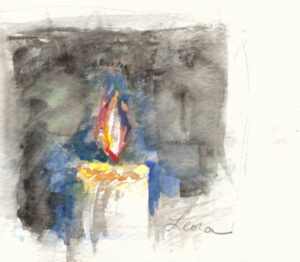
I needed to send someone a condolence card. Someone who sat shiva (one sits shiva for seven days for a close relative, in this case a brother) far away. So I painted two watercolors of yahrzeit candles. I’ve never painted lit candles before, and it wasn’t easy. I chose one to send. Here are both the watercolors:



My neighbor grew these hibiscus flowers right next to my backyard so I could photograph them for Ruby Tuesday. Right? This is not the neighbor with the potted red plants, the one who paints the Jersey Shore. This is the neighbor who cooks with influences of North African, Persian and French cuisine. I have nice neighbors.

 I make salmon a fair amount throughout the year. My basic recipe is quite simple: I use an oval ceramic dish, and I poach the salmon in the oven with some water and lemon juice.
Ingredients:
Optional: onion, sliced tomato, sliced potato
Preheat oven to 350°. Place fish in ceramic baking dish with water and lemon juice, enough to cover the fish. Place something green and flavorful along side the fish, such as dill or celery. Optionally, you can put sliced tomato and onion under the fish, or sliced potato and onion. Bake for 30-45 minutes. Use a fork to test the middle to see if the fish is thoroughly cooked.
Pink sauce for fish:
Take some red beet horseradish and mix it with either plain yogurt or sour cream. Serve on top or beside the fish.
During the nine days before Tisha B’Av, the ninth day of the Jewish month of Av, observant Jews do not eat meat (except on Shabbat). Fish is a possible option that one can serve during the Nine Days.

And don't forget to submit a post to the Kosher Cooking Carnival by August 12!
Here's the blog carnival submission form.

As I won’t be posting again until Sunday morning, I thought I would leave this pretty orange flower at the top of my blog until then. Can anyone identify it? I took the photo in Jerusalem.
This is probably an eschscholzia (thank you, Ilana-Davita!)


I don’t really mean to freak my readers out with the first two photos, but the New Jersey turnpike around Elizabeth, Newark and Linden is really what gives New Jersey a bad name. These don’t even show the worst of it, which we passed when I was driving my son to the bus stop for sleepaway camp last week. He took the photos.
Just to prove that our state is actually mostly much prettier than this, I took these in Hope, New Jersey in a wonderful little amusement park, water park and outdoor theatre in which the audience can participate:

My daughter, husband and I participated in a play in the front of this castle. She was a princess, he was the dragon (a major role!), and I played the skunk:

After I took the above photo, it did rain on us. But not too much.
Since the sky was glorious blue this morning, I’ll finish up with these two photos taken in front of my home:


For more Skywatch participants, please visit:

My kids like bagels. So we spend time going to bagel shops.
If any of you grew up within 600 miles of New York City, you may know that New York is well known for its bagels. And bagels are often associated with folks of those parts as a “Jewish” food.
Well, it may or may not surprise you to know that in the early days of the State of Israel, the 1950s – 1970s, it was very difficult if not impossible to find a bagel in the Jewish State. I was first in Israel in 1980, and I cannot remember eating bagel while there. I remember pizza, especially Richie’s pizza. But not bagels. Pita, fresh rolls, yes, but I don’t remember bagels.
It was a nice surprise on this past trip to Israel (my fifth time visiting) that we enjoyed not just one but two bagel shops in the city of Jerusalem. At left my son is happily chomping on a poppy seed bagel from Bonkers Bagel in the Old City.
Below you will see my daughter munching a pizza bagel at Holy Bagel on Rechov Yaffo:

How did these bagels shops rate? Hey, they were happy. And that makes mommy happy.
However, the bagel story in our home town of Highland Park, New Jersey is a bit of a sadder tale. We used to have this wonderful bagel shop just over the border in Edison on Rte. 27. They served delicious fresh bagels, and I remember buying the egg salad bagel with tomato and red onion when my son was a mere babe. However, at some point that bagel store departed, and a new one opened in Highland Park. The new bagel shop wasn’t nearly as good as the old one, both for reasons that the bagels weren’t as good and the service was, well, lousy. The new bagel shop changed owners and then closed completely. There is a Bagel Dish Cafe here in Highland Park, but alas, it is not kosher.
Now when we want bagels in Highland Park, we go to: Dunkin’ Donuts!
I should tell you the best part of our Dunkin’ Donuts is great service. Part of the way they give great service is they yell at you if you are chatting online, and it’s your turn to give your order. They keep the line moving fast, and the people behind the counter remember you. And what you ordered last time. The friendly service is quite nice. Personally, my favorite is the multigrain bagel, because of the oatmeal and sunflower seeds on top.
During the school year some teenage boys ran a service where you could order bagels from Teaneck. I don’t know much about the service or about the Teaneck bagels, but as my son will be going to school in Teaneck in September, I expect I might ask him to buy a few bagels for us.
Years ago when my husband and I were dating we used to go to a nice bagel shop on 72nd Street on the West Side in Manhattan. They served bagels, coffee, orange juice and scrambled eggs for one price, and under the glass on the tables were comic strips. Whatever it was called, it probably is no longer there.
In Brookline, Massachusetts (I grew up in nearby Newton) at Kupel’s Bagels on Harvard Street you could get green bagels on St. Patrick’s Day. Probably still can.
Any decent bagel shops where you live?
If you haven’t had enough photos of bagel shops in Jerusalem, visit Dina.

Ah, siblings. Sometimes they get along. Sometimes they squabble. Sometimes one helps the other out, like my Eldest Son did as he carried my daughter through the Old City of Jerusalem on our way to visit the Kotel. I really appreciated his offer to carry her.
Anyone got a good sibling tale to relate?