This is a “baby” blog. It was born in December 2007. One of the ways I hope to bring it from babyhood to toddlerdom is by honoring my commenters.
Taking a cue from the Rambam, the twelfth-century philosopher and expert in Jewish law who talks about 8 degrees of charity, I came up with 4 levels of commenting etiquette.
Level One: this is kind of a pre-level. It just learning how to leave a comment on someone else’s blog. You are not writing a whole post, but stating something in as clear a fashion as you can.
Level Two: Thank those who leave comments on your site. I still remember when I posted a comment on E-Kvetcher’s site on loshon hara (laws of gossip–a topic I would like to blog about, some time, some day). Look what a nice comment he left for me, after I left a few longish comments (I initiated the use of the term ‘blab’): “Leora, welcome and feel free to blab away.”
Level Three: If someone comments on your site, and you have never visited their site, go back and visit their site. And leave a comment. On something. Here was Jack’s first comment on my site, on my anti-pantyhose post: “Men are far more practical. No pantyhose, no pumps, no girdles.” So I went back to his site to find a post on which I could leave a comment. No comment on the particular post I found; it was one of Jack’s strange ones. I’ll give a link to Jack’s Comments on Commenting instead.
Level Four: Finally, the highest level is to link to a blogger or a blogger’s post in one of your posts. Search engines don’t follow the links in comments. But they do follow the links in posts. So here are links to blog posts by people who commented in the past week:
Radishes are just about the easiest vegetable to grow. This lovely seedling and other radish seedlings have shown up in my garden in the past week. About one month ago I planted some radish, dill and marigold seeds. No sign of the dill or marigolds germinating. May not be warm enough or long enough for them yet. Seeds germinate at different rates and different temperatures. Radishes are quick to germinate!
I’ve participated in two blog carnivals, and here are the links: Haveil Haveilim 161: Pidgeon Break
I looked up “pidgeon” and found this:
rats with wings, a person, usually a martin, with a barrel chest and pronounced curve in their rig that makes their ass trail behind their shoulders by an inch or so.
In a fit of insanity, I seemed to have volunteered to do the August Kosher Cooking Carnival. More on that much, much later.
It is a lot of fun to participate in these carnivals. Humor and waffle jokes fly about (though many of the posts are serious and seriously informative, especially in Haveil Haveilim). Kudos to all the hosts and bloggers.
I did this painting about two years ago. The subject is havdalah, the ceremony after the end of Shabbat that we do every week. After saying the havdalah prayer, my husband pours a little wine (or grape juice) unto a plate, and I put the candle in the liquid to extinguish the flame. Can spot the two little cloves, symbolic of the besamim (spices) that we smell so we should have a good week? (Shavua tov = good week)
The havdalah in oils painting has a Rembrandtesque quality that I love.
Rabbi Jonathan Sacks has a nice d’var torah on Parshat Tazria. Why is circumcision a sign of the covenant? First, he tells a bit about life during the time of Hosea:
Hosea lived in the eighth century BCE. The kingdom had been divided since the death of Solomon. The northern kingdom in particular, where Hosea lived, had lapsed after a period of peace and prosperity into lawlessness, idolatry and chaos. Between 747 and 732 BCE there were no less than five kings, the result of a series of intrigues and bloody struggles for power. The people, too, had become lax: “There is no faithfulness or kindness, and no knowledge of God in the land; there is swearing, lying, killing, stealing and committing adultery; they break all bounds and murder follows murder” (Hos. 4: 1-2).
He then contrasts the word Ba’al, which means husband in Hebrew but also refers to the idol of those times, with the word Ish.
[Ba’al] was also, of course, the name of the Canaanite god – whose prophets Elijah had challenged in the famous confrontation at Mount Carmel. Baal (otherwise known as Hadad, and usually portrayed as a bull) was the god of the storm, who defeated Mot, the god of sterility and death. Baal was the rain that impregnated the earth and made it fertile. In terms of myth, Baalism is the worship of god-as-power.
In contrast, Ish(man) and Ishah(woman) are explained:
Here the male-female relationship is predicated on something quite other than power and dominance, ownership and control. Man and woman confront one another in sameness and difference. Each is an image of the other, yet each is separate and distinct. The only relationship able to bind them together without the use of force is marriage-as-covenant – a bond of mutual loyalty and trust in which each makes a pledge to the other to honour one another and the reciprocal duties that bind them together in a moral bond.
His conclusion:
Now we understand why the sign of the covenant is circumcision. For faith to be more than the worship of power, it must affect the most intimate relationship between men and women. In a society founded on covenant, male-female relationships must be built on something other and gentler than male dominance, masculine power, sexual desire and the drive to own, control, possess. Baal must become ish. The alpha male must become caring husband. Sex must be sanctified and tempered by mutual respect. The sexual drive must be circumcised and circumscribed so that it no longer seeks to possess and is instead content to love.
Aside from me: so does this mean in Birkat HaMazon, the blessing after meals, I can say “Ishee instead of Baalee”? (Both mean my husband)
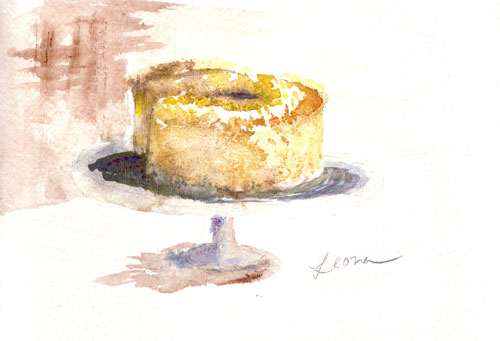
Sponge Cake 2008, watercolor by Leora Wenger
Has anyone heard of Esther Robfogel of Rochester, New York? This is really her sponge cake recipe. It is from the Rochester Hadassah Cookbook, which was given to me as an engagement present by mother’s friend from Rochester. Her friend used to make ten sponge cakes a day before Pesach (Erev Erev Pesach), and she gave away about seven. One year our family was one of the lucky recipients of one of these sponge cakes. A few years later, after remembering the delicious taste of that cake, I taught myself to make sponge cake using Esther Robfogel’s recipe, which she titled: Never-Fail Sponge Cake.
Ingredients:
9 eggs, separated
1 1/2 cups sugar
1/2 cup cake meal
1/4 cup potato starch
Juice and rind of 1 lemon or orange
Beat egg whites until they hold their shape; add sugar slowly. Beat yolks and add lemon juice and rind. Fold in cake meal and potato starch. Fold in beaten yolks. Pour into large size ungreased tube pan. Bake in 325° or 350° oven for 50-60 minutes. Invert on cake rack and let cool in pan.
And don’t do what I did my first year of trying this and use a square aluminum pan. You need to use a tube or bundt pan, or your never-fail cake will fail to bake properly.
This past Sunday my daughter had the pleasure of attending an art and yoga workshop for ages 4 -7 here in Highland Park with Jill. Daughter made it clear she didn’t want me to leave her. I said OK, as I also wanted to watch Jill do a workshop (she’s very talented and good with kids; she teaches art to my Middle Son). And I took pictures.
One of my daughter’s friends came, so that relaxed her a bit. Jill first asked the kids to say their names and tell about what they like. My daughter was shy. Jill then did some yoga with the kids. When it came time for art, which my daughter usually loves, she came into the corner with me instead of going to the art mat. I went over to the art mat and pretended that I was going to do the art instead. Finally, she came over and did the art project. All the kids decorated funky suns.
My daughter eventually got really into the project.
You can see that she has some of her dollies with her to keep her company.
At the end, Jill taught the kids to do the sun pose. My daughter, however, was by then focused on her tummy, which was announcing that it was lunch time. So we left quickly at the end and thanked Jill on our way out.
I tend to be fond of blogs with visual content. Not surprising, as I am an artist. So here’s where I’ve been recently:
Batya posted scenes of spring last week. It is fun to compare spring in one part of the world to the other; at first I mistook her grape vine shot for forsythia, but now that I can compare the two photos I see that grape vines are much woodier.
I’ve been noticing that A Simple Jew has simply great visual taste. Take a look at this landscape painting, by Rhode Axel who I think is really Meir Alexlrod(1902-1970), a Russian artist who may have never even seen the subject of the painting, namely the Golan. Note the use of cool, distancing blue in the background against the complementary warm fiery orange in the foreground. Another interesting visual choice by A Simple Jew: a bearded father reads a great big book, presumably a gemarah, while the little boy in a cap plays the violin. Contrast it with the subject matter of the post; in the drawing, it is the boy who yearns for the father’s attention. In the post, Chabakuk Elisha asks how can we get kids attracted to Yiddishkeit.
Finally, I posted a comment to this post on Iconia, and I got an email back asking me about my artwork in connection to religion. Like my four cups or candles. Stay tuned for more at a later point…
A week ago I posted about Z., a friend of Ann who is very ill with cancer. Z.’s father regularly writes posts in a password-protected blog on the hospital website. Ann gave me access to these posts, and they are touching. And disturbing. It is clear that this is an important emotional release for Z.’s father. Z. was hospitalized so they could improve her pain medication. She will be coming home soon and receiving hospice care.
Some quotes from the letters:
I wish that I knew what Z. was thinking and feeling. We respond to her pain, try to understand her increasingly garbled speech, guess at what might make her less uncomfortable, and tell her that we love her, almost all of the time.
and
Thanks for your posts, your emails, your prayers, your love and warmth. And for our fellow Cagers and bball fans who are going to Greensboro, give a yell and clap really hard for our team. Tell them Z. sent you.
Go, Rutgers.
Love and Peace,
[Z.’s father’s name]
Finally,
As one of my friends has said right along, “no parent expects to watch his child die. It is our own personal Holocaust.”
Sometimes people mis-use the term “Holocaust”. Not here.
Unfortunately, too many families have suffered such a loss. Here’s another family’s story.

 This is a “baby” blog. It was born in December 2007. One of the ways I hope to bring it from babyhood to toddlerdom is by honoring my commenters.




 Forsythias are named after William Forsyth, an 18th century Scottish horticulturist.
 A week ago I