I had a tough week. Busy with work (three meetings in a row with three different clients) and then the real anxiety-provoker, dealing with my father’s surgery. He’s doing well. So I got the chance to write my most creative post last night:
Keyword and Link Challenge: I am challenging you, my readers, to put your favorite post (can be yours or someone else’s) in the comments of that post. Then I’ll come up with a post using a few of those links. Sort of like paper bag dramatics: you put a bunch of objects in a box, then you and your group put on a skit.
I have another picture from the parade I hope to post for Summer Stock Sunday. This was my first entry for that summery meme hosted by Robin: Summer Beach Items
Nature Notes: New Moon (aside note: best wishes to Michelle in dealing with her mom, who is in the hospital)
I didn’t get a chance to do a Weekly Review last week, so here’s an artsy post: Flower Power Painting
Stay tuned for a scribbly, fun art post last Saturday night Eastern time.
Elsewhere on the Web
Klara, who runs a Yahoo group for macrobiotics, wrote that the newest member is Jen Hoy, who writes for About.com. If you want some ideas for tantalizing salads, visit her post on summer salads. You don’t have to adopt the whole diet to make one delicious and healthy salad!
…it makes me angry that my living in my home is equated with terrorists killing innocent men, women, and children. Am I really as dangerous as a suicide bomber? I am a suburban mom raising three kids, and have never threatened anyone…
Do ever check your blog statistics and say, huh? That’s what people searched for and found my blog?
One of the most common search terms on my blog seems to be dogwood. OK, so at one point I took a couple of great shots of my neighbor’s dogwood tree in bloom. But that’s the most common search term? Another highly ranked search term is hawthorn tree. I’ll have to accept that one; I did spend a fair amount of time photographing and researching the lovely red berry tree I found around the corner until I was informed it was a hawthorn.
Do you want a little more control over your best keyword, your best link? Here’s an idea that may or may not work.
In the comments, post your favorite link on your blog. Or your favorite link on my blog. Or on your friend’s blog. (You have my permission to post more than one link – but three would be spamming – just to set limits to this little game).
Alternatively,
list 3 keywords that you actually searched for in Google (or some other search engine).
Or do both the link challenge and the keyword challenge.
Next week, I will craft a post (or two or three) that includes a few of those posts. I will then write up some descriptions that have keywords that are in those posts. It will be interesting to watch one stats to see if this has any effect. Of course, if others do the same (if you take three of the posts people liked and write up a post about those posts, including keywords in your title tag and your description), we may see better results. If you do decide to write a post to emphasize certain keywords, please use those keywords in the title tag. Title tags are one of the most important sections in a post that search engines use to determine relevance and ranking.
Regarding the three keywords that you used to search in Google, it would be fun to craft a post based on those keywords. A bit like paper bag dramatics, no?
In my Ruby Tuesday post this week I asked if anyone could guess which business sponsored this float from the Israel Day Parade in New York City. It turns out it was sponsored by IDB Bank, Bank HaPoalim, and Bank Leumi. Robin, who lives in Tel Aviv, correctly stated Bank Leumi as the sponsor.
Whenever I hear Bank HaPoalim, I think of the ditty: “Bo-ee, bo-ee-tan-u, Bank HaPoalim, bo-ee, bo-ee-tan-u, Bank HaPoalim …” (which translates as ‘come with us, come with us, Bank of the Workers, come with us, come with us, Bank of the Workers). Do they still use that for advertising? I have no idea. The name ‘Bank HaPoalim,’ bank of the workers, reminds me of Israel’s socialist, Russian-inspired roots.
Purple Iris, photographed in May 2009
Since I don’t have to craft a full post (I would love to write a tech, business or even a recipe), I present an iris and these “postalinas” (mini one sentence posts):
Working on a new, free online course with Professor Roni Stauber for the Rutgers Bildner Center on the History of Zionism.
Discovered a great post on Drupal vs. WordPress. And yes, I still want to develop expertise in both Drupal and WordPress. I will be working soon on converting a regular HTML website to WordPress so the small business owner can manage his own site.
Have a recipe for onions and mushrooms that is so simple but so delicious. Maybe next week I’ll post it?
Planning an exciting Nature Notes post for Thursday, courtesy of an email I got from Klara.
Which of these postalinas have meaning for you? Do you like the term ‘postalina’?
Lots of reds were visible at the Salute to Israel Parade down Fifth Avenue in New York City yesterday. This was one float with many red balloons that said “Ruby Tuesday” red to me.
These drummers at the Fifth Avenue Israel parade also seemed to be wearing red t-shirts so they can show up in a Ruby Tuesday post.
I photographed this red rhododendron a few minutes before we marched off to the local Highland Park Memorial Day Parade.
Extra: since some of you like quizzes, can anyone guess what the first float is representing? Which business? Hint: it is an Israeli-based business that has branches in New York.
Last week I took a trip down to the Native Plant Reserve (NPR) in Highland Park. Here is the willow amsonia in bloom. I recognize the flower from years ago when I put together a guessing game of native plants from NPR.
I think I should do these Nature Notes posts every other week; I need one week to come up with an idea and take photos, and the next week to put it together in a post. Or maybe I should just take it one week at a time and rely on inspiration.
It’s great when the plants have a sign, like this red switch grass.
This one is called spiderwort; good name for a plant with spidery-like leaves.
I had a hard time getting a good shot of the buttercups. If I had my other lens, the macro lens, it would have been easier, because these are tiny and close to the ground.
What’s going on in your area? Birds, flowers, animals, trees? Visit Michelle’s Nature Notes for more natural wonders.
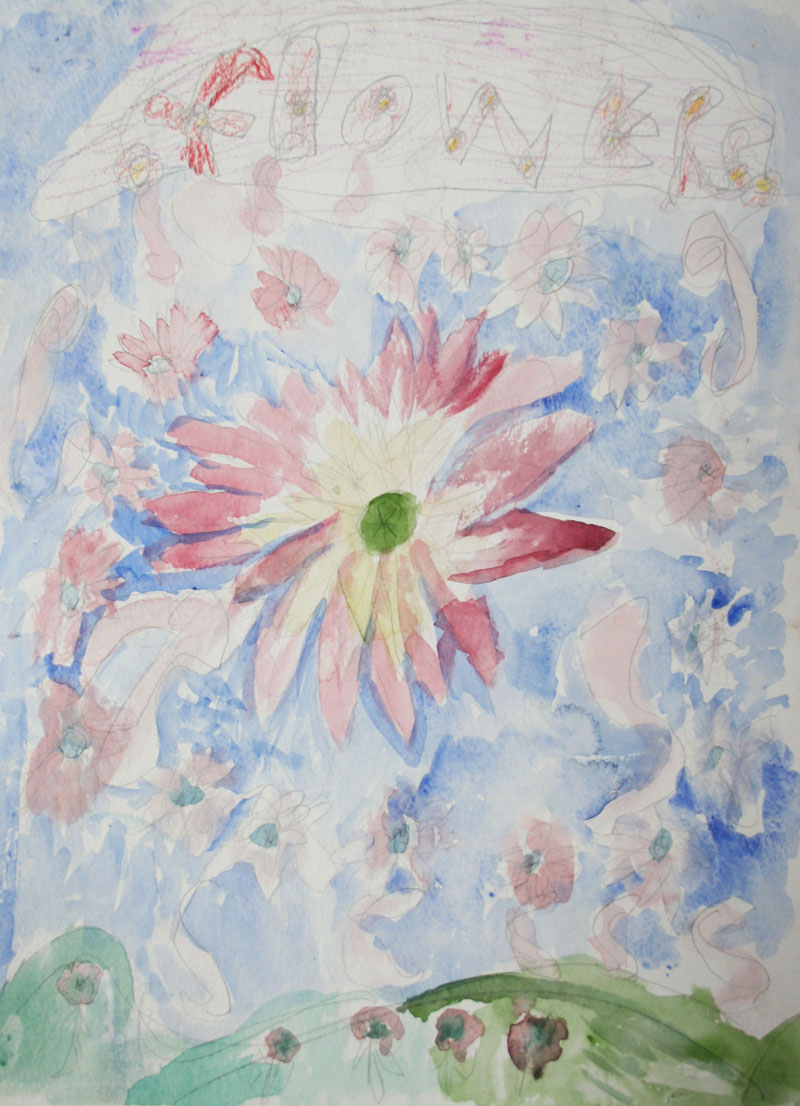
My daughter painted this on Sunday afternoon. I only did the blue background, at her request, because she felt I would be more careful about not painting over the objects in the painting. I also did one darker green line, in my efforts to show her that if one adds a color in several different tones (say, light, dark and medium), one can achieve more of a sense of realism. My daughter wasn’t terribly interested in my words of wisdom, but she did request that I put this on the blog. She was looking at my geranium perennial when she painted this; I hope to post some photos of that lovely plant sometime in the next week or so.
What do blooming garden flowers and the shocker I used for a title have in common?
In S. Y. Agnon’s short story “The Sign” the main character learns that all the Jews in his hometown in Europe have been killed by the Nazis. He learns this at the same time his house in the Land of Israel has been decorated for Shavuot in the traditional way, with flowers and plants:
The sun shone down on the outside of the house; inside, on the walls, we had hung cypress, pine, and laurel branches, and flowers. Each beautiful flower and everything with a sweet smell and been brought in to decorate the house for the holiday of Shavuot. In all the days I had lived in the Land of Israel, our house had never been decorated so nicely as it was that day. All the flaws in the house had vanished, and not a crack was to be seen, either in the ceiling or in the walls. From the places where the cracks in the house used to gape with open mouths and laugh at the builders, there came instead the pleasant smell of branches and shrubs, and especially of the flowers we had brought from our garden. These humble creatures, which because of their great modesty don’t raise themselves high above the ground except to give off their good smell, made the eye rejoice because of the many colors with which the Holy One, blessed be He, has decorated them, to glorify His land, which, in His loving-kindness, He has given to us.
A little later in the story Agnon teaches us a little of the halachot (laws) of Shavuot:
Although on the Sabbath and festivals one says the evening prayers early, on Shavuot we wait to say Maariv until the stars are out.
For if we were to pray early and recieve the holiness of the festival, we would be shortening the days of the Omer, and the Torah said, “There shall be seven full weeks.”
Later, the main character is standing in the synagogue, facing the six memorial candles shining among the roses and the wildflowers and the garden flowers that have been used to decorate the sanctuary. “Is it possible that a city full of Torah and life is suddenly uprooted from the world, and all its people—old and young; men, women and children—are killed, that now the city is silent, with not a soul of Israel left in it?”
Who is S. Y. Agnon? Shmuel Yosef Agnon was born Shmuel Yosef Czaczkes in Buczacz, Galicia. In 1908 he immigrated to Israel and in 1913 he went to Germany, where he married his wife. He returned to Israel in 1924. If you have heard of Saul Bellow or Isaac Bashevis Singer, S. Y. Agnon won the Nobel Prize for Literature in 1966, years before Saul Bellow and Isaac Bashevis Singer won their Nobel Prizes. Agnon wrote his stories in Hebrew, one of the first modern writers to do so. I hope one day to read his stories in Hebrew, as one loses a lot in translation.
Many thanks to Lorri (Rayna Elianna) for recommending A Book That Was Lost: Thirty Five Stories (Hebrew Classics),a lovely book of short stories. The holiday of Shavuot, which is a major Jewish holiday (as opposed to say, Chanukah, which is only a minor holiday) begins on Thursday night, May 28th. It is traditional to decorate one’s home with flowers, to stay up all night learning Torah, and to eat dairy dishes (we’ll be having ice cream for dessert).
Who can tell why I am posting white flowers for a Ruby Tuesday post? The answer is very red.
In honor of memorial day, here are three pics from our local parade down Raritan Avenue. The motorcyclist is so un-me (the clothes, the motorcycle, the whole look), but I liked the photo and wanted to share it.
My friend is the leader of this Girl Scout troop. I used to march when I was a Cub Scout Leader.
To me, this picture says “Memorial Day.” We have so much to thank for, living in this country because of those who fought for our freedoms. May those who lose their lives fighting for freedom be remembered and cherished.
For more photos with a little red or a lot of red: